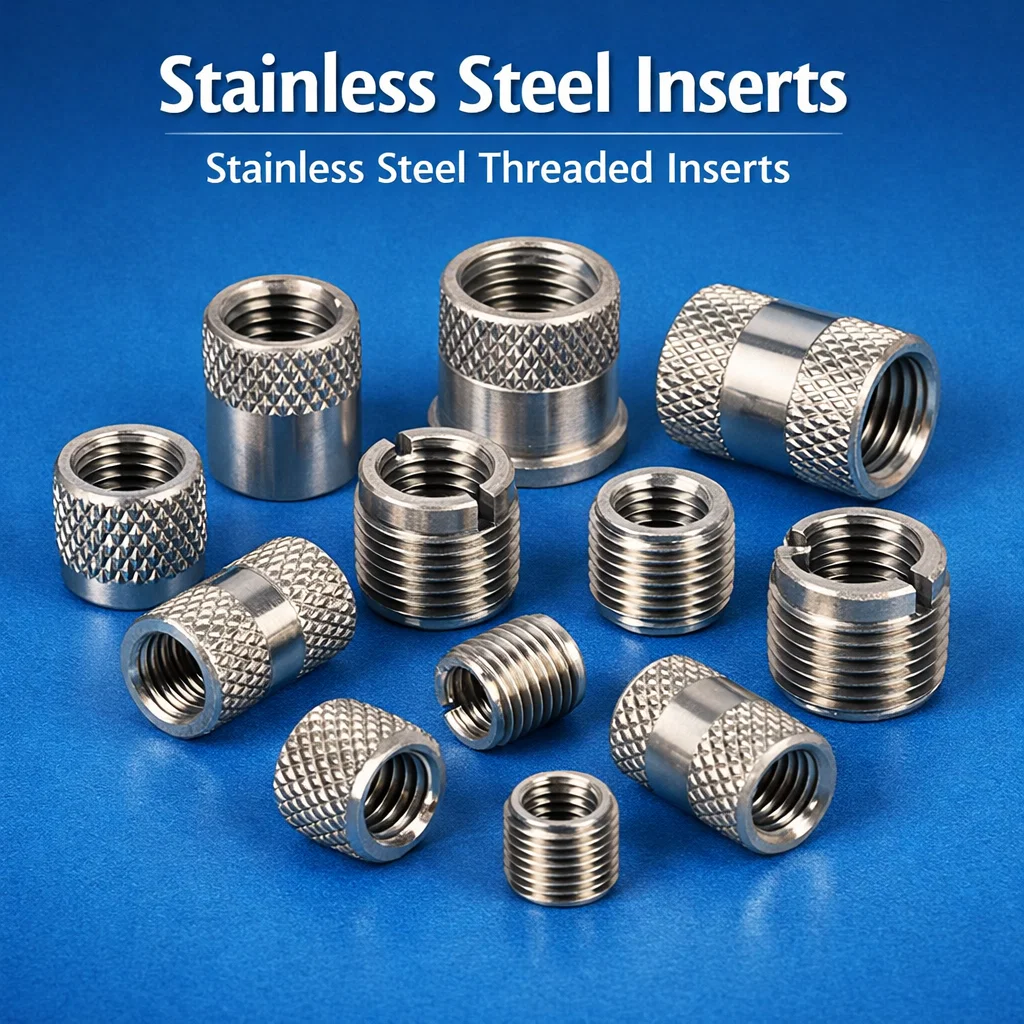
Stainless Steel Threaded Inserts – Precision-Engineered Molding Inserts for Demanding Applications

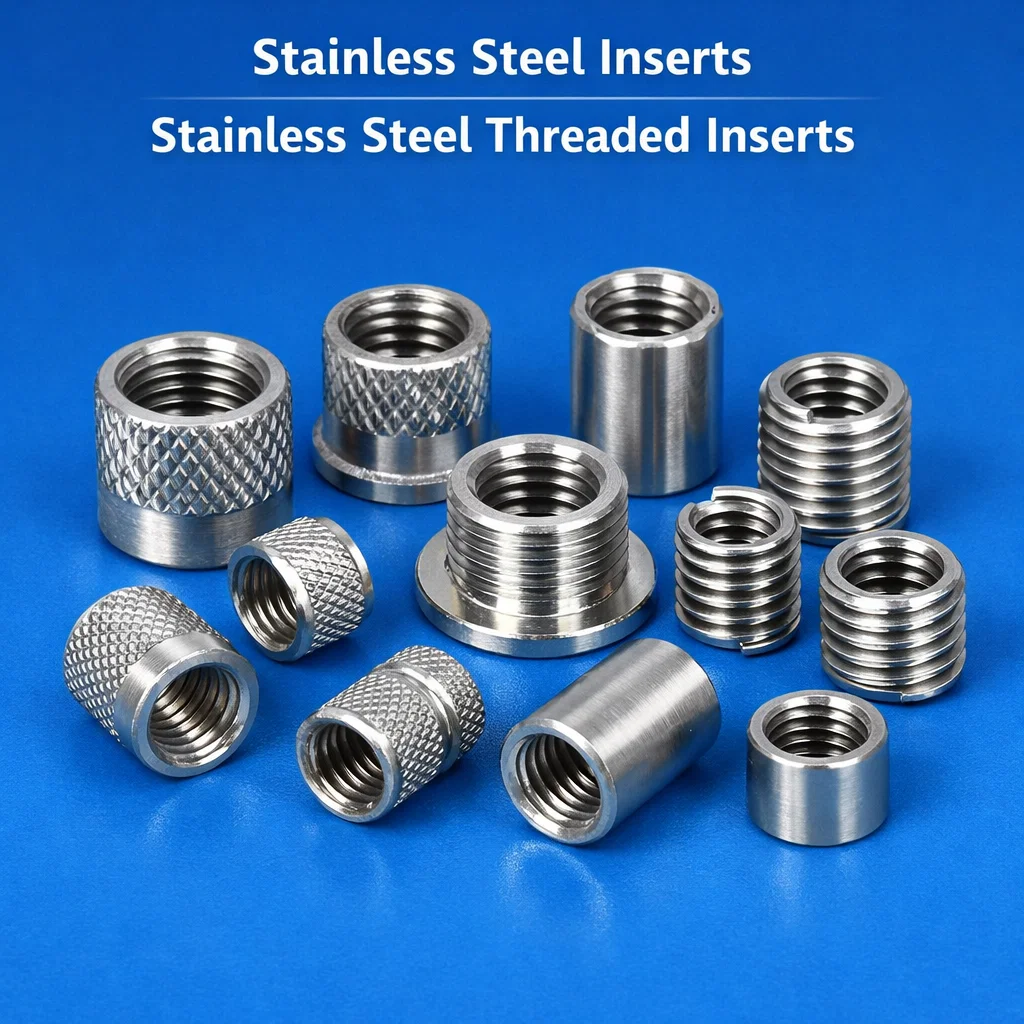
Brass Copper Parts manufactures stainless steel threaded inserts and stainless steel molding inserts for applications requiring superior corrosion resistance, mechanical strength, and long-term thread integrity. Designed for embedding into thermoplastic, thermoset, and composite materials, these inserts deliver reliable load transfer and vibration resistance across electrical, industrial, and marine environments. Available in Grade 304 and Grade 316, with UNC and Metric thread forms, our stainless steel inserts conform to international dimensional and quality standards.
Product Overview
Stainless steel threaded inserts are precision-machined fastener components installed into molded or machined holes to create durable, load-bearing internal threads. Unlike brass inserts, stainless steel variants offer enhanced resistance to oxidation, chloride-induced corrosion, high-temperature environments, and aggressive chemical exposure. They are widely used wherever dissimilar metal contact, galvanic corrosion, or hygienic requirements prohibit the use of brass or zinc alloys.
Brass Copper Parts produces stainless steel molding inserts through CNC turning on Swiss-type and multi-spindle machines, with knurling, thread rolling, and slotting operations performed in-house. All inserts are dimensionally verified against drawing and customer specification before dispatch.
Key Features
- Corrosion Resistance: Grade 304 and 316 stainless steel provides excellent resistance to oxidizing acids, moisture, and salt spray environments.
- High Tensile Strength: Withstands pull-out forces and torque loads significantly exceeding brass equivalents in thin-wall molded sections.
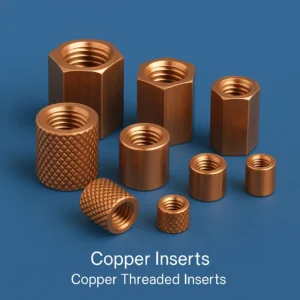
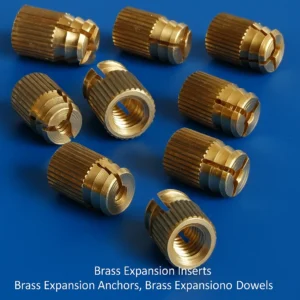
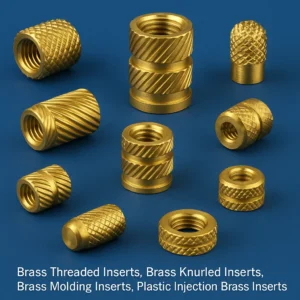
- Knurled Outer Profile: Diamond and straight knurl patterns ensure positive mechanical lock within the host material during and after molding.
- Full Thread Range: Available in M2 to M20 (Metric) and #4-40 to 1/2″-13 (UNC) thread sizes.
- Tight Tolerances: Machined to ISO 286 tolerance classes; thread form verified per ISO 965 / ANSI B1.1.
- Clean-Room Compatible: 316 grade variants are suitable for food-grade and pharmaceutical mold tooling.
- RoHS Compliant: No restricted hazardous substances; suitable for export to EU markets.
- Custom Configurations: Non-standard lengths, flanged heads, blind-end, or through-hole variants available on request.
Technical Specifications
Material Grades and Properties
| Property | Grade 304 (1.4301) | Grade 316 (1.4401) |
|---|---|---|
| Tensile Strength (MPa) | 515 min | 515 min |
| Yield Strength (MPa) | 205 min | 205 min |
| Hardness (HRB) | 92 max | 95 max |
| Density (g/cm³) | 7.93 | 7.98 |
| Max Service Temp (°C) | 870 | 870 |
| Corrosion Resistance | Good – general environments | Superior – chloride / marine |
| Magnetic | Non-magnetic (annealed) | Non-magnetic (annealed) |
International Grade Equivalents
| Standard | Grade 304 Equivalent | Grade 316 Equivalent |
|---|---|---|
| ASTM / AISI (USA) | 304 / S30400 | 316 / S31600 |
| EN / DIN (Europe) | 1.4301 / X5CrNi18-10 | 1.4401 / X5CrNiMo17-12-2 |
| JIS (Japan) | SUS 304 | SUS 316 |
| BS (UK) | 304 S31 | 316 S31 |
| IS (India) | 04Cr18Ni10 | 04Cr17Ni12Mo2 |
| GB (China) | 0Cr18Ni9 | 0Cr17Ni12Mo2 |
Dimensional Range
| Parameter | Metric Series | UNC Series |
|---|---|---|
| Thread Size Range | M2 – M20 | #4-40 – 1/2″-13 |
| Insert Length Range | 4 mm – 30 mm | 3/16″ – 1-1/4″ |
| Outer Diameter Tolerance | ±0.02 mm | ±0.001″ |
| Thread Class | 6H (ISO 965) | 2B (ANSI B1.1) |
| Surface Finish (Ra) | 0.8–1.6 µm | 32–63 µin |
Product Types and Variants
By Installation Method
- Press-In / Mold-In Inserts: Installed during the molding cycle; outer knurl locks mechanically into the host polymer as it solidifies.
- Heat-Set Inserts: Post-mold installation using a heated probe; thermoplastic flows around the knurl on cooling.
- Ultrasonic Inserts: Installed via ultrasonic welding equipment; suitable for ABS, PC, nylon, and acetal.
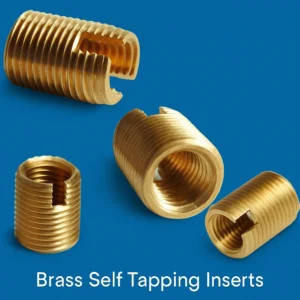
- Self-Tapping Inserts: Installed by direct torque drive; thread cuts into pre-drilled hole in softer plastics.
By Head Configuration
- Flush / Headless (standard molding insert profile)
- Flanged head (increased pull-out resistance)
- Thin-wall low-profile flanged
- Blind-end (closed bottom for sealing applications)
By Knurl Pattern
- Diamond knurl (bidirectional locking)
- Straight knurl (axial pull-out resistance)
- Spiral / helical knurl (combined axial and torsional resistance)
Applications by Industry
Electrical and Electronics Manufacturing
Used in switchgear enclosures, control panel housings, junction box covers, and PCB standoff assemblies where brass is not suitable due to galvanic compatibility requirements or environmental exposure.
EPC and Power Utilities
Specified in outdoor instrument enclosures, cable management systems, transformer terminal boxes, and metering equipment subject to humid, saline, or chemically aggressive site conditions.
Marine and Offshore
Grade 316 stainless inserts are preferred for junction boxes, navigation equipment housings, and composite structural panels on vessels and offshore platforms.
Food Processing and Pharmaceuticals
316 grade inserts meet hygiene requirements for equipment frames, conveyor housings, and process enclosures subject to frequent wash-down with chlorinated or caustic solutions.
Automotive and Industrial Equipment
Used in under-hood plastic components, sensor housings, and structural panels where heat and vibration resistance of stainless steel is required.
Manufacturing Process
All stainless steel threaded inserts are machined from cold-drawn stainless steel bar stock (ASTM A276 / EN 10088) on CNC Swiss-type screw machines and CNC turning centers. The process sequence includes:
- Bar stock verification: Incoming material is tested for grade, hardness, and chemical composition using optical emission spectroscopy (OES).
- CNC turning: Outer diameter, bore, and length machined to drawing tolerances on multi-axis CNC lathes.
- Thread cutting / rolling: Internal threads produced by thread rolling (preferred) or thread cutting to ISO 965 / ANSI B1.1 class tolerances.
- Knurling: Outer knurl applied by CNC knurling tool to specified pattern and pitch.
- Deburring and cleaning: Vibratory deburring followed by ultrasonic cleaning to remove machining residues.
- Dimensional inspection: Go/no-go thread gauging, optical dimensional measurement, and surface finish verification.
- Passivation (optional): Electrochemical passivation per ASTM A967 available for enhanced corrosion performance.
- Packaging: Anti-tarnish polyethylene bags, labeled per customer part number and ROHS declaration.
Quality Standards and Certifications
| Standard / Certification | Scope |
|---|---|
| ISO 9001:2015 | Quality Management System – design, manufacture, and supply |
| RoHS 2015/863/EU | Restriction of Hazardous Substances compliance |
| ASTM A276 / A484 | Stainless steel bar stock specification |
| ISO 965-1 | Metric thread tolerance and fit |
| ANSI B1.1 | UNC/UNF Unified thread standard |
| ASTM A967 | Passivation specification for stainless steel parts |
| ISO 286 | Dimensional tolerances for machined components |
Why Choose Brass Copper Parts for Stainless Steel Inserts
- Dedicated Stainless Machining Capability: Separate CNC cells for stainless to prevent cross-contamination with brass/copper alloys.
- Grade-Specific Material Traceability: Full heat traceability from raw material certificate to finished component.
- Tight Dimensional Control: All inserts 100% thread-gauged; critical dimensions verified by optical CMM.
- Flexible MOQ: Sample quantities from 500 pieces; production runs from 10,000 pieces.
- Custom Engineering Support: Application-specific insert design assistance including pull-out strength calculations.
- Export Packaging: Compliant with ISPM-15 and EU import documentation requirements.
- Fast Lead Times: Standard sizes shipped ex-stock; custom profiles in 3–5 weeks.
Frequently Asked Questions
What is the difference between 304 and 316 stainless steel inserts?
Grade 304 contains 18% chromium and 10% nickel, offering good general corrosion resistance. Grade 316 adds 2–3% molybdenum, which significantly improves resistance to chloride pitting and crevice corrosion. For marine, coastal, or food-processing environments, 316 is the preferred specification.
Can stainless steel inserts be used in the same mold tooling as brass inserts?
Yes. Stainless steel inserts share the same outer diameter and knurl profile as equivalent brass inserts in most standard series. Mold tooling modifications are not required when substituting grades, provided dimensional specifications are matched.
What plastic materials are compatible with stainless steel mold-in inserts?
Compatible materials include ABS, polycarbonate (PC), nylon (PA6, PA66), POM acetal, PBT, polypropylene (PP), PEEK, and most thermoset epoxy and polyester compounds. Material selection affects installation method (mold-in, heat-set, or ultrasonic).
Are UNC threaded stainless steel inserts available in both Grade 304 and 316?
Yes. All UNC thread sizes from #4-40 to 1/2″-13 are available in both 304 and 316. Metric threads from M2 to M20 are similarly available in both grades. Non-standard sizes can be manufactured to customer drawing.
Do you supply material test certificates (MTC) with stainless steel inserts?
Yes. Mill test certificates (EN 10204 Type 3.1 or 2.2) are available for all stainless steel grades as standard. Test reports confirming chemical composition and mechanical properties accompany each shipment on request.
What is the pull-out strength of stainless steel molding inserts?
Pull-out strength varies by insert size, thread engagement length, host material, and installation method. Stainless steel inserts typically achieve 10–20% higher pull-out performance than brass equivalents in the same host material due to higher base metal hardness. Application-specific pull-out data is available on request.
Can passivated stainless steel inserts be supplied?
Yes. Electrochemical passivation per ASTM A967 is available as an additional process step. Passivation removes free iron from the machined surface, enhancing the formation of the chromium oxide passive layer and improving corrosion resistance in aggressive environments.
What is the minimum order quantity (MOQ) for custom stainless steel inserts?
For non-standard or custom-profile stainless steel inserts, the minimum order quantity is 1,000 pieces per part number. Standard catalog sizes are available from 500 pieces. Samples for qualification testing are available from 50–100 pieces against drawing approval.
Are your stainless steel inserts RoHS and REACH compliant?
Yes. All stainless steel grades used by Brass Copper Parts are RoHS 2015/863/EU and REACH SVHC compliant. Declarations of conformity are issued with each order and available in our quality documentation package.
Do you offer knurled stainless steel inserts for composite laminates?
Yes. Diamond-knurl and straight-knurl profiles are available for embedding into fibre-reinforced polymer (FRP), carbon fibre, and glass-filled composite laminates. For composites, through-hole flanged inserts with wider flange diameters are recommended for optimal load distribution.
Request a Quote or Technical Datasheet
For volume pricing, custom specifications, or material certifications for stainless steel threaded inserts or stainless steel molding inserts, contact our technical sales team. Provide thread size, grade (304 or 316), quantity, and installation method. Datasheets, dimensional drawings, and pull-out test data are available on request.
Email: sales@brass-copper-parts.com | Phone: +91-22-43449300