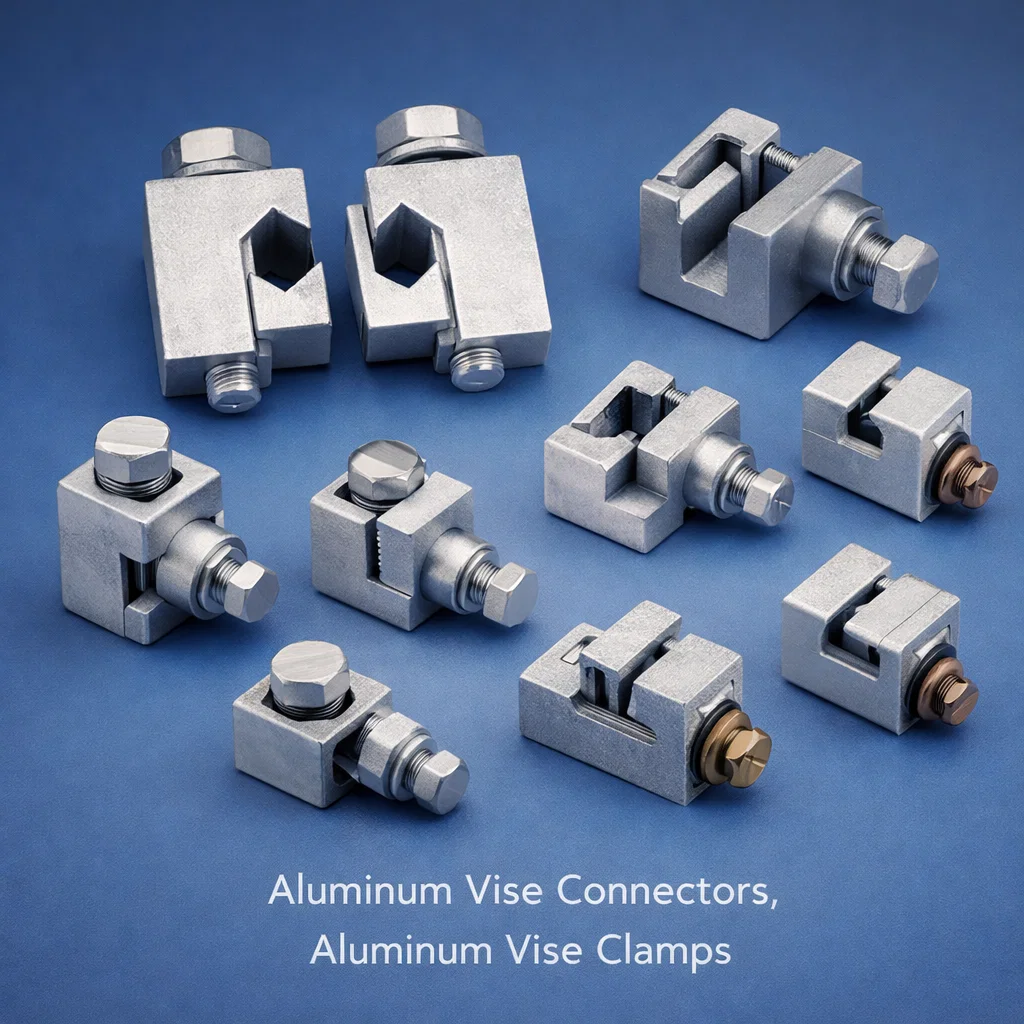
Aluminum Vise Connectors & Aluminum Vise Clamps
Aluminum vise connectors (also called vise-type connectors, wedge clamps, or dead-end vise connectors) are mechanical overhead power line fittings that use a screw-actuated or wedge-action vise jaw mechanism to create a gas-tight, vibration-proof mechanical and electrical connection on aluminum or ACSR overhead conductors — without the need for crimping tools, hydraulic compressors, or specialized field equipment. Brass & Copper Parts India manufactures aluminum vise connectors and vise clamps to ANSI C119.4, IEEE 837, IEC 61284, and utility-specific standards — supplying USA power utilities, EPC overhead line contractors, rural electric cooperatives (RECs), utility material suppliers, and international power distribution project contractors. Vise connectors are a preferred jointing technology in distribution line construction and maintenance for their tool-free installation, excellent performance in vibration and thermal cycling, and reliable long-term contact resistance.
Product Overview
An aluminum vise connector consists of an extruded or forged aluminum alloy body containing one or more vise jaws (hardened aluminum or stainless steel) actuated by hex head cap screws. When the cap screws are torqued to the specified value (typically 14–40 N·m depending on size), the vise jaws grip the conductor strands and create a gas-tight, current-carrying joint that meets the contact resistance requirements of ANSI C119.4 Class A or B. Vise connectors are used for straight-line dead-end terminations, tee taps (T-connections from run conductor to branch), service entrance connections, and transformer secondary connections. No crimping equipment is needed — connections are made with a standard torque wrench, making them especially valuable for remote rural line work.
Key Features
- No Crimping Equipment Required: Vise connectors are installed with a standard hex key and torque wrench — eliminating the need to transport hydraulic compression tools or power units to field locations, reducing installation cost and equipment investment for line crews.
- ANSI C119.4 Class A Rated: Our vise connectors meet ANSI/IEEE C119.4 Class A performance requirements for sustained current, current cycling, short circuit withstand, and vibration resistance — the highest performance class for overhead conductor connectors.
- Multi-Conductor Size Range in Single Connector: Vise connectors are designed to accommodate a range of conductor sizes in a single connector body (e.g., #4 AWG to 4/0 AWG AAC) — reducing stock-keeping complexity for utilities and contractors serving multiple conductor sizes.
- Gas-Tight Vise Joint: Screw-actuated vise jaws displace the conductor oxide layer under controlled force and create a gas-tight interface that resists oxidation and maintains low contact resistance over the connector’s service life.
- Corrosion-Resistant Aluminum Alloy Body: Main connector body in AA6061-T6 or AA6082-T6; set screws in hardened stainless steel or zinc-plated alloy steel for galvanic compatibility with aluminum conductors.
- Multiple Configuration Options: Available as dead-end (straight line), tee (H or T connector for branch tap), and universal configurations for run-and-tap connections at distribution poles and service entrance points.
Technical Specifications
| Parameter | Specification |
|---|---|
| Material (Body) | AA6061-T6 or AA6082-T6 extruded / forged aluminum |
| Material (Set Screws) | Stainless steel or hardened alloy steel (zinc plated) |
| Conductor Compatibility | AAC, ACSR, AAAC, ACAR (bare aluminum conductors) |
| Conductor Size Range | #6 AWG to 1000 kcmil (per size variant) |
| Performance Class | ANSI C119.4 Class A or Class B |
| Contact Resistance | ≤ 110% of equivalent conductor resistance (ANSI C119.4) |
| Current Cycling | Pass 25 cycles at 135°C per ANSI C119.4 |
| Installation Tool | Standard hex key + calibrated torque wrench |
| Torque Specification | 14–40 N·m (size dependent) |
| Standards | ANSI C119.4, IEEE 837, IEC 61284 |
Aluminum Alloy Grade Equivalents
| AA (USA) | IS (India) | EN/BS | DIN | JIS | UTS |
|---|---|---|---|---|---|
| AA6061-T6 | IS 7920 HE20 | EN AW-6061 | AlMg1SiCu / 3.3211 | A6061 | 310 MPa min |
| AA6082-T6 | IS 7920 HE30 | EN AW-6082 / H30 | AlSi1MgMn / 3.2315 | A6082 | 340 MPa min |
| AA6351-T6 | IS 7920 | EN AW-6082 | AlMgSi | A6351 | 310 MPa min |
Product Types and Variants
Single-Conductor Vise Dead-End Connectors (Straight Line)
Single-conductor straight-line vise dead-end connectors are used to terminate an overhead conductor at a pole, deadend structure, or anchor point with a screw-tightened vise grip and a clevis or bail attachment for the strain insulator. The conductor is inserted into the connector bore and the set screws are torqued to specification with a torque wrench to create a gas-tight mechanical and electrical connection. Available for AAC and ACSR conductors from #6 AWG to 795 kcmil, these connectors meet ANSI C119.4 Class A current rating and are the standard product used by USA electric cooperatives and investor-owned utilities for distribution dead-end construction.
T-Type (Tee Tap) Vise Connectors
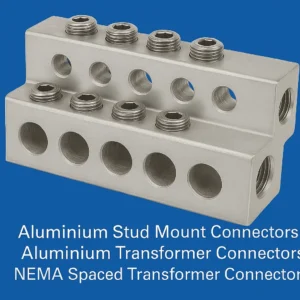
T-type vise connectors create a branch tap connection between a run conductor and a branch service or distribution conductor without cutting or splicing the run conductor — a critical feature for live-line tap connections. The run conductor passes through one bore of the T-connector and is gripped by set screws; the branch conductor is inserted into the perpendicular bore and gripped by a separate set of screws. Both connections are independently tightenable. T-type vise connectors are used for transformer pole-top primary connections, street lighting branch taps, and service entrance connections to a live distribution main. Available in same-conductor and reducing-conductor configurations from #6 AWG to 4/0 AWG.
H-Tap (Run-and-Tap) Vise Connectors
H-tap vise connectors (also called run-and-tap connectors) accommodate both the run conductor and a tap conductor in an H-shaped body, where the run conductor channel accepts the full conductor range without being terminated and the tap channel accepts the branch conductor. Unlike T-type connectors, H-taps allow the run conductor to be threaded through without cutting. These are the most common tap connector type used in USA distribution line construction for transformer primary connections, streetlight branch circuits, and suburban distribution line taps. Available in single and double-bolt (for larger conductor sizes) configurations in ANSI C119.4 Class A and Class B performance levels.
Reducing Vise Connectors (Run-to-Branch Reduction)
Reducing vise connectors accommodate two different conductor sizes — a larger run conductor and a smaller branch conductor — in the same connector body. This eliminates the need for a separate reducer fitting when the branch circuit conductor is smaller than the main run. Available in common utility combinations such as 4/0 AWG run x #2 AWG branch and 336 kcmil run x 1/0 AWG branch. The independent set screw actuating system for each conductor bore ensures that each conductor is gripped at the correct torque without affecting the other — maintaining optimal contact resistance on both conductors simultaneously.
Multi-Tap Vise Connectors (3-Way and 4-Way)
Multi-tap vise connectors provide three or four branch tap positions from a single connector body — used at transformer secondary poles, metering points, and distribution junction structures where multiple circuits branch from a common main conductor. Each tap position has independent set screws for individual conductor installation and tightening. Multi-tap configurations reduce pole-top clutter and installation time compared to using multiple individual H-tap connectors. Available for AAC/ACSR conductors from #6 AWG to 4/0 AWG, with 3-way and 4-way branch configurations in AA6061-T6 extruded bodies.
Applications by Industry
- Power Distribution and Utility Maintenance: Primary and secondary conductor connections at distribution poles, service drops, transformer primary connections, and metering point taps on overhead distribution systems (4 kV to 35 kV).
- Rural Electric Cooperatives (RECs): Simple, tool-free vise connectors reduce equipment requirements for remote rural line work where transporting hydraulic compression equipment is impractical — a major advantage for cooperative line crews.
- EPC Overhead Line Construction: New line construction for dead-end terminations, pole-top tap connections, and service entrance connections on AAC and ACSR conductor distribution systems.
- Urban and Suburban Distribution: Secondary service connections, streetlight branch taps, and residential service entrance connections on low-voltage overhead secondary distribution systems.
- Telecom and Cable TV Infrastructure: Structural messenger cable dead-end connections and strand attachments on combined utility poles carrying power and telecom cables.
Manufacturing Process
Vise connector bodies are extruded or forged from AA6061-T6 or AA6082-T6 aluminum billet, then CNC-machined to final dimensions. The conductor bores are drilled or reamed to specified conductor diameter ranges with controlled surface finish inside the bore to ensure metal-to-metal contact with conductor strands. Set screw holes are drilled and tapped with precision tap tooling to thread class 6H. Stainless steel or hardened alloy set screws are assembled and torque-tested per lot. All connectors undergo electrical contact resistance testing per ANSI C119.4 on a sampling basis, with mechanical pull-out tests to verify vise grip strength. Material test certificates, dimensional inspection records, and electrical test reports are provided with each batch.
Quality Standards and Certifications
- ISO 9001:2015 Certified
- Performance qualification per ANSI C119.4 Class A (current cycling, short circuit, vibration)
- Material conformance to ASTM B221 (extruded bar) with EN 10204 3.1 certs
- Electrical contact resistance per ANSI C119.4 ≤ 110% of equivalent conductor
- Mechanical pull-out test to utility-specified minimum pull-out force per conductor size
- Third-party testing by KEMA, Intertek, or UL available for utility qualification programs
Why Choose Brass & Copper Parts India
- ANSI C119.4 Compliance: Full qualification test reports to ANSI C119.4 Class A available for utility approval programs — the key prerequisite for approved vendor status with USA utilities and RECs.
- Complete Overhead Line Hardware Range: Vise connectors, PG clamps, stirrup clamps, and neutral bars all available from a single source — simplifying procurement for distribution line projects.
- Utility Specification Experience: Worked to individual utility specifications for PEPCO, Duke Energy, Eversource, and international utilities — capable of custom conductor range and torque specifications.
- Competitive Bulk Pricing: Container-load shipments to USA utility material warehouses with competitive pricing, full test documentation, and ANSI C119.4 qualification.
Frequently Asked Questions
What is the difference between a vise connector and a compression connector?
A compression (crimp) connector is permanently deformed onto the conductor using a hydraulic compression tool and die set — it cannot be removed without cutting. A vise connector uses screw-actuated jaws that can be tightened and, in principle, released — it requires only a torque wrench for installation. Vise connectors offer easier field installation but compression connectors are preferred for highest-integrity permanent joints where tampering resistance is required.
What does ANSI C119.4 Class A mean?
ANSI/IEEE C119.4 is the USA standard for connectors for use between aluminum-to-aluminum or aluminum-to-copper conductors in overhead line service. Class A is the highest performance class, requiring the connector to pass 25 current-cycling tests, short-circuit current withstand, mechanical pull-out, and vibration testing while maintaining contact resistance ≤ 110% of the equivalent conductor resistance. Class B requires fewer test cycles and is used for lower-criticality applications.
What conductor types work with vise connectors?
Vise connectors are compatible with AAC (ASTM B231), ACSR (ASTM B232), AAAC (ASTM B399), and ACAR overhead bare aluminum conductors. They are not suitable for steel ground wire (OPGW or ACSR steel core only) or insulated conductors without the insulation being stripped back. Always verify the connector’s conductor size range covers your specific conductor AWG or kcmil rating before installation.
What torque should I use to tighten vise connector set screws?
Torque specifications are provided on each connector and in the installation instructions — they range from approximately 14 N·m (10 ft·lb) for small connectors (up to #2 AWG) to 40 N·m (30 ft·lb) for large connectors (250 kcmil and above). A calibrated torque wrench must be used; under-torquing risks poor contact, over-torquing risks conductor damage. Always refer to the manufacturer’s installation sheet for the specific model.
Can vise connectors be used for underground distribution?
Vise connectors are specifically designed for overhead bare conductor applications. For underground distribution, different connector types (underground (URD) connectors, split-bolt connectors, or insulated taps) are required that are rated for direct buried or direct-buried-in-duct service. Contact us to confirm the correct connector type for your specific application.
What is the minimum order quantity?
Sample/evaluation orders: 25–50 pieces per size for utility approval testing. Standard orders: MOQ 100 pieces per SKU with full test documentation. Bulk utility supply: container-load pricing for 500+ pieces per SKU, with framework agreement pricing available for annual utility programs.
Suggested Internal Links
- All Aluminum Parts
- Aluminum Alloy Stirrup Clamp Hotline Bail Clamp (related product)
- Aluminum PG Clamps Parallel Groove Clamps (related product)
- Aluminum Terminal Bars and Neutral Bars (related product)
- Electrical Accessories
Request a Quote for Aluminum Vise Connectors and Vise Clamps
Brass & Copper Parts India supplies ANSI C119.4 Class A aluminum vise connectors and vise clamps to USA power utilities, rural electric cooperatives, and EPC distribution line contractors. Provide your conductor type, AWG/kcmil range, configuration (dead-end, T-tap, H-tap), quantity, and utility specification number for a technical and commercial quotation. Enquire now.
Product categories
Related Products
-

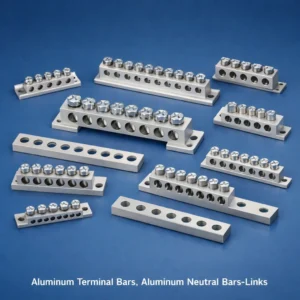
Aluminum Terminal Bars, Aluminum Neutral Bars-Links
₹8.70 Add to cart -
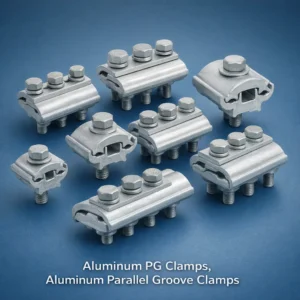
Aluminum PG Clamps, Aluminum Parallel Groove Clamps
₹8.70 Add to cart -
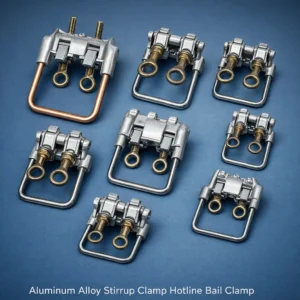
Aluminum Alloy Stirrup Clamp Hotline Bail Clamp
₹8.70 Add to cart -
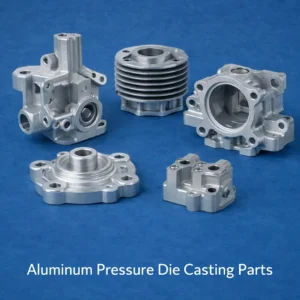
Aluminum Pressure Die Casting and Aluminum PDC Parts
₹8.70 Add to cart -
Aluminum Gravity Casting and Gravity Cast Parts
₹8.70 Add to cart -
Aluminum Brackets, Aluminum Pipe Brackets (Pressed)
₹8.70 Add to cart -
Aluminum Screw Machine Parts
₹8.70 Add to cart -
Aluminum Washers, Pressed Aluminum Washers
₹8.70 Add to cart -
Aluminum Stamped Parts, Aluminum Stamping
₹8.70 Add to cart -
Aluminum Manifolds, Aluminum Hydraulic Manifolds
₹8.70 Add to cart -
Aluminum Stud Mount Connectors, Aluminum Transformer Connectors,
₹8.70 Add to cart -
Aluminum Parts, Aluminum Turned Components
₹8.70 Add to cart -
Aluminum Hotline Clamps
₹8.70 Add to cart -
Aluminum CNC machined Parts, Aluminum Components
₹8.70 Add to cart