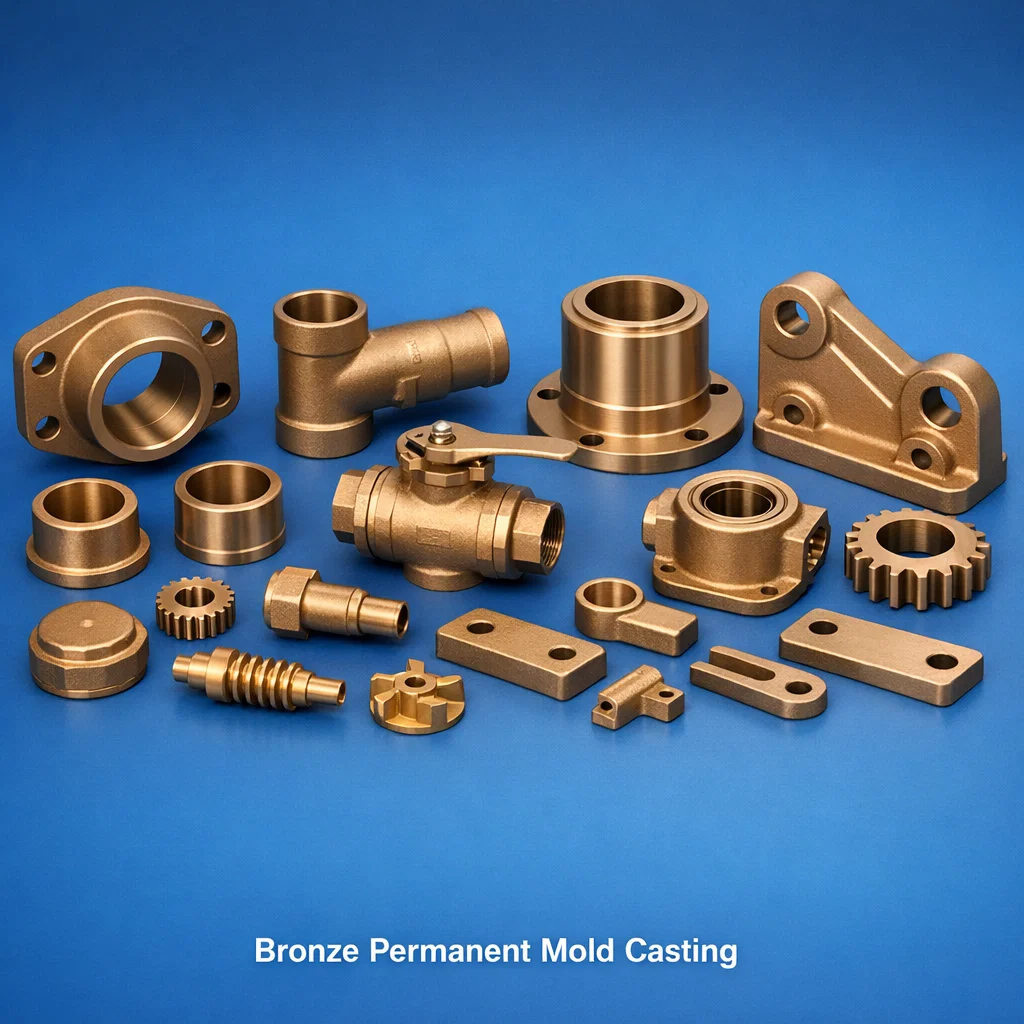
Bronze Permanent Mold Casting
Bronze permanent mold casting uses reusable steel or cast iron dies to produce bronze components with superior dimensional accuracy, fine surface finish, and improved mechanical properties compared to sand casting, by leveraging the heat extraction and dimensional stability of the permanent metal mold. The process encompasses gravity die casting (GDC), low-pressure die casting (LPDC), and tilt-pour casting of bronze alloys including LG2 (C83600), phosphor bronze (C90500), aluminum bronze (C95400), tin bronze (G1), and lead-free tin bronze for bearing, valve, pump, marine, and precision engineering applications. Brass & Copper Parts operates bronze permanent mold casting facilities producing components from 0.05 kg to 10 kg, with production rates and quality levels intermediate between sand casting and investment casting, at tooling costs substantially below investment casting wax die tooling.
Product Overview
Bronze permanent mold casting is particularly suited for medium-to-high volume production of bronze components in the 0.1 kg to 5 kg weight range, where green sand casting is too variable dimensionally and investment casting tooling investment is not justified by component geometry or volume. The metal die provides 50,000–200,000 shots of service life, amortizing tooling cost over large production quantities. Rapid heat extraction through the metal die refines the bronze grain structure versus sand cast bronze, improving hardness, wear resistance, and tensile strength by 10–20% for the same alloy composition. Brass & Copper Parts has developed die design expertise for bronze alloys including optimized venting, gating, and cooling channel design that accounts for the different thermal properties and shrinkage behavior of tin bronze, aluminum bronze, and leaded gunmetal alloys.
Key Features
- Dimensional accuracy CT5–CT7 – Superior to sand casting CT8–CT11, suitable for close-fit components
- Improved mechanical properties – Fine-grained structure from metal die solidification
- Good pressure tightness – Suitable for PN10–PN16 bronze valve, pump, and fitting applications
- High production rates – 100–300 pieces/hour for small bronze components
- Reduced machining allowance – Better as-cast surfaces reduce stock removal and tool wear
- Multi-alloy capability – LG2, phosphor bronze, aluminum bronze, lead-free tin bronze
- Reusable tooling economics – Lower per-piece tooling cost than investment casting for volumes above 2,000/year
Technical Specifications
| Property | C83600 (LG2) | C90500 (Phos. Bronze) | C95400 (Al. Bronze) |
|---|---|---|---|
| Tensile Strength (MPa) – PMC | 260–290 | 330–380 | 620–680 |
| Yield Strength (MPa) – PMC | 110–130 | 145–175 | 250–280 |
| Hardness (HB) – PMC | 70–90 | 80–100 | 160–210 |
| Elongation (%) – PMC | 18–25 | 16–22 | 10–15 |
| Surface Finish (Ra μm) | 3.2–6.3 | 3.2–6.3 | 3.2–6.3 |
| Dimensional Tolerance | CT5–CT7 | CT5–CT7 | CT5–CT7 |
| Min. Wall Thickness (mm) | 3 | 3.5 | 4 |
International Grade Equivalents
| ASTM/CDA | BS 1400 | EN 1982 | DIN 1705 | IS 318 |
|---|---|---|---|---|
| C83600 | LG2 | CC491K | G-CuSn5ZnPb | LG2 |
| C90500 | PB2 | CC480K | G-CuSn10 | Grade 2 |
| C90700 | PB4 | CC483K | G-CuSn12 | Grade 1 |
| C95400 | AB1 | CC331G | CuAl10Fe3 | – |
Product Types and Variants
Bronze PMC Valve Bodies and Fittings
Bronze LG2 (C83600) permanent mold casting produces valve bodies, check valve casings, globe valve bodies, and pipe fittings with CT5–CT7 dimensional accuracy and Ra 3.2–6.3 μm surface finish — significantly better than green sand cast equivalents. PMC bronze valve bodies exhibit consistent internal bore geometry and uniform wall thickness, reducing machining cycle times for seat lapping, thread cutting, and bore finishing. For PN10/PN16 rated bronze valve bodies from ½” to 3″ bore, permanent mold casting provides production economics competitive with sand casting above 1,000 pieces/year while delivering quality closer to investment casting. Hydrostatic pressure testing at 1.5× rated pressure is standard for all PMC bronze valve castings from Brass & Copper Parts.
Phosphor Bronze PMC Bearings and Wear Components
Phosphor bronze C90500 and C90700 permanent mold cast bearing bushings, thrust washers, guide pads, and wear rings achieve higher hardness and wear resistance compared to equivalent sand castings of the same alloy, due to the fine grain structure produced by rapid solidification in the metal die. PMC phosphor bronze bearings are produced in bore diameters from 10 mm to 150 mm, with wall thicknesses from 3 mm to 25 mm, at production rates significantly higher than centrifugal casting for small-to-medium sizes. These components are used in pump shaft bushings, valve stem bushings, machine tool slideways, and agricultural equipment bearing applications where the improved hardness (80–100 HB for C90500 PMC vs 70–90 HB for sand cast) provides longer service life.
Aluminum Bronze PMC High-Strength Components
Aluminum bronze C95400 permanent mold cast components achieve tensile strengths of 620–680 MPa and hardness of 160–210 HB — exceeding equivalent sand cast properties — due to the rapidly quenched dendritic microstructure produced in the metal die. PMC aluminum bronze is used for cam followers, wear pads, gear segment inserts, marine hardware, and hydraulic actuator components where high strength, wear resistance, and corrosion resistance must coexist with dimensional precision above sand casting capability. Brass & Copper Parts produces aluminum bronze PMC components from 0.1 kg to 5 kg, with die cooling channels optimized for the higher pouring temperature (1100–1180°C) of aluminum bronze versus lower-temperature gunmetal and phosphor bronze alloys.
Bronze PMC Pump Components
Pump impellers, wear rings, and bearing brackets in LG2 (C83600) and phosphor bronze (C90500) are permanent mold cast for water pump, fire pump, and HVAC circulation pump OEM manufacturers at volumes of 2,000–50,000 pieces per year where investment casting tooling cost is not justified. PMC pump impellers achieve closer hydraulic geometry accuracy than sand cast equivalents (CT5–CT7 vs CT8–CT10), improving pump efficiency and reducing hydraulic balancing requirements. Brass & Copper Parts has developed multi-cavity PMC dies for standard pump impeller sizes (50 mm to 200 mm diameter), enabling same-week production scheduling on repeat orders from established tooling.
Lead-Free Tin Bronze PMC for Environmental Compliance
Lead-free tin bronze permanent mold castings in C90200 (CuSn6) or C90300 (CuSn8) alloys are produced for potable water pump components, food processing equipment, and medical device components where leaded alloys are restricted by environmental regulations. These alloys maintain good bearing properties and corrosion resistance while achieving lead content below 0.05%, compliant with EU Directive 2011/65/EU (RoHS) restrictions on lead in certain product categories. Brass & Copper Parts maintains dedicated lead-free bronze PMC production lines with segregated raw material storage and dedicated furnaces to prevent lead cross-contamination of lead-free alloy batches.
Bronze PMC Marine Hardware
Bronze permanent mold cast marine hardware including fairlead bodies, cleat bases, stanchion sockets, portlight frames, and seacock operating handles in LG2 (C83600) and aluminum bronze (C95400) provides dimensional consistency and surface quality for visible marine hardware components where sand cast surface roughness and dimensional variability are commercially unacceptable. PMC marine bronze hardware is produced with as-cast surfaces Ra 3.2–6.3 μm, suitable for direct chrome or nickel plating or polishing for decorative marine applications. Standard marine hardware sizes are maintained as stock PMC tooling for fast delivery on repeat hardware orders.
Applications by Industry
| Industry | Bronze PMC Components |
|---|---|
| Valve Manufacturing | LG2 valve bodies, check valves, fittings (PN10/PN16) |
| Pump Manufacturing | Impellers, wear rings, bearing brackets (50–200mm diameter) |
| Bearing Applications | Phosphor bronze bushings, thrust washers, guide pads |
| Marine Hardware | Fairleads, cleats, portlights, seacock handles, deck fittings |
| General Engineering | Cam followers, wear pads, gear inserts, hydraulic components |
| Food & Pharma | Lead-free tin bronze pump components, bearing bushings |
Manufacturing Process
Bronze PMC at Brass & Copper Parts uses H13 tool steel dies with precision-machined cavities, gating, and cooling channel circuits. Dies are preheated to 180–250°C (LG2/phosphor bronze) or 220–280°C (aluminum bronze) before production. Molten bronze at the alloy-specific pouring temperature is ladled into the die — either manually with controlled pour speed or automatically by pouring robot with load-cell metered pour weight. Solidification is completed in 20–90 seconds depending on section thickness and alloy. Die temperature is maintained within ±15°C of target by water cooling channel flow regulation. Post-casting operations include extraction, flash trimming in matched press trim dies, shot blasting, spectrometric analysis, dimensional gauging, and hydrostatic pressure testing for valve and fitting applications. Material test certificates per EN 10204 Type 3.1 accompany every production batch.
Quality Standards and Certifications
- ASTM B584 – Applicable to LG2, phosphor bronze, aluminum bronze PMC
- BS 1400 LG2, PB2, PB4, AB1 – British standard for respective bronze grades
- EN 1982 CC491K, CC480K, CC483K, CC331G – European standards
- ISO 8062-3 – Dimensional tolerances CT5–CT7
- ISO 9001:2015 – Quality management system
- EN 10204 Type 3.1 – Material test certificates
Why Choose Brass & Copper Parts
Brass & Copper Parts has built specialized bronze permanent mold casting capability across LG2, phosphor bronze, and aluminum bronze alloys with dedicated die design expertise for each alloy’s thermal and shrinkage characteristics. Our in-house die shop manufactures H13 tool steel PMC dies with CNC die-sinking capability, ensuring die cavity accuracy of ±0.05 mm. We offer die life guarantee of 100,000 shots minimum for standard bronze PMC applications, with scheduled die maintenance intervals to maintain dimensional compliance throughout tool life. Full machining, pressure testing, and certification services are integrated with PMC production for complete finished-part supply.
Frequently Asked Questions
Can bronze PMC castings be used as direct replacements for sand cast bronze?
Yes, in most cases. Bronze PMC castings conform to the same alloy standards (ASTM B584, BS 1400, EN 1982) as sand cast equivalents, with equal or better mechanical properties. The main differences are improved dimensional accuracy (CT5–CT7 vs CT8–CT10) and better surface finish — both desirable improvements. The practical limitation is weight: bronze PMC is most economical below 5–10 kg, while sand casting handles unlimited weight range.
What is the die life expectancy for bronze PMC tooling?
H13 steel dies for LG2 and phosphor bronze PMC (pouring temperature 1000–1100°C) typically last 100,000–200,000 shots before cavity refurbishment. Aluminum bronze PMC dies (pouring temperature 1100–1180°C) have shorter die life — typically 50,000–100,000 shots — due to higher thermal loading. Die life monitoring via shot count recording and periodic dimensional cavity inspection is implemented at Brass & Copper Parts, with planned die refurbishment or replacement before dimensional drift affects casting quality.
What is the difference between tilt-pour and straight gravity pour for bronze PMC?
Straight gravity pour: the die is stationary and metal is poured directly into the sprue. This is faster but introduces more turbulence, potentially entraining oxide films and gas. Tilt-pour: the die and ladle start horizontal, with metal pre-loaded in the ladle cavity; the die-ladle assembly tilts to vertical, allowing metal to flow smoothly into the cavity with minimal turbulence. Tilt-pour produces cleaner bronze castings with fewer oxide inclusions — important for pressure-tight valve and gas fitting applications.
How does bronze PMC compare to centrifugal casting for bearings?
Centrifugal casting produces superior density and porosity elimination in hollow cylindrical components (bushings, rings, sleeves) due to the centrifugal pressure consolidation. For cylindrical bearings, centrifugal casting is generally preferred for bore diameters above 50 mm where centrifugal consolidation significantly improves bearing life. For smaller, more complex bearing shapes (flanged bushings, eccentric bushings, bearing caps), PMC is preferred due to its ability to produce complex external geometry in a single operation.
What is the minimum tooling investment for bronze PMC?
A single-cavity H13 die for a standard bronze valve body or bearing component costs approximately USD 4,000–10,000 depending on complexity and cavity size. Multi-cavity tooling increases investment but reduces per-piece cost. Break-even versus sand casting typically occurs at 2,000–5,000 pieces/year considering improved yield, reduced machining, and better quality. Brass & Copper Parts offers tooling amortization arrangements for committed production volume contracts.
Request a Quote
Brass & Copper Parts manufactures bronze permanent mold castings in LG2, phosphor bronze, aluminum bronze, and lead-free tin bronze for valve, pump, bearing, marine, and engineering applications. Contact our technical team for tooling and production pricing.
Contact us: sales@brass-copper-parts.com | +91-22-43449300
Product categories
Related Products
-

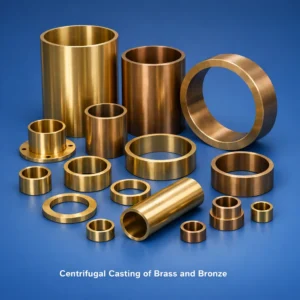
Centrifugal Casting of Brass and Bronze
₹13.40 Add to cart -
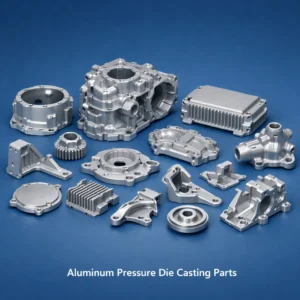
Aluminum Pressure Die Casting Parts
₹8.70 Add to cart -
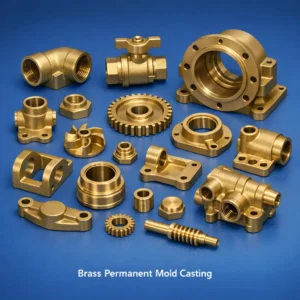
Brass Permanent Mold Casting
₹11.80 Add to cart -
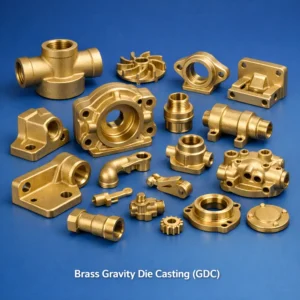
Brass Gravity Die Casting GDC
₹11.80 Add to cart -
Stainless Steel 304 and 316 Sand Casting
₹8.90 Add to cart -
Stainless Steel Investment Casting
₹8.90 Add to cart -
Aluminum Bronze Investment Casting
₹8.70 Add to cart -
Bronze Shell Molding, Shell Casting
₹13.40 Add to cart -
Gunmetal Casting Foundry
₹13.40 Add to cart -
83600 Bronze Casting, CDA 836 Bronze Casting
₹13.40 Add to cart -
LG2 Bronze Casting 85-5-5-5
₹13.40 Add to cart -
Phosphor Bronze Casting
₹13.40 Add to cart -
Lead Free Brass Casting
₹11.80 Add to cart -
Aluminum Bronze Casting
₹8.70 Add to cart