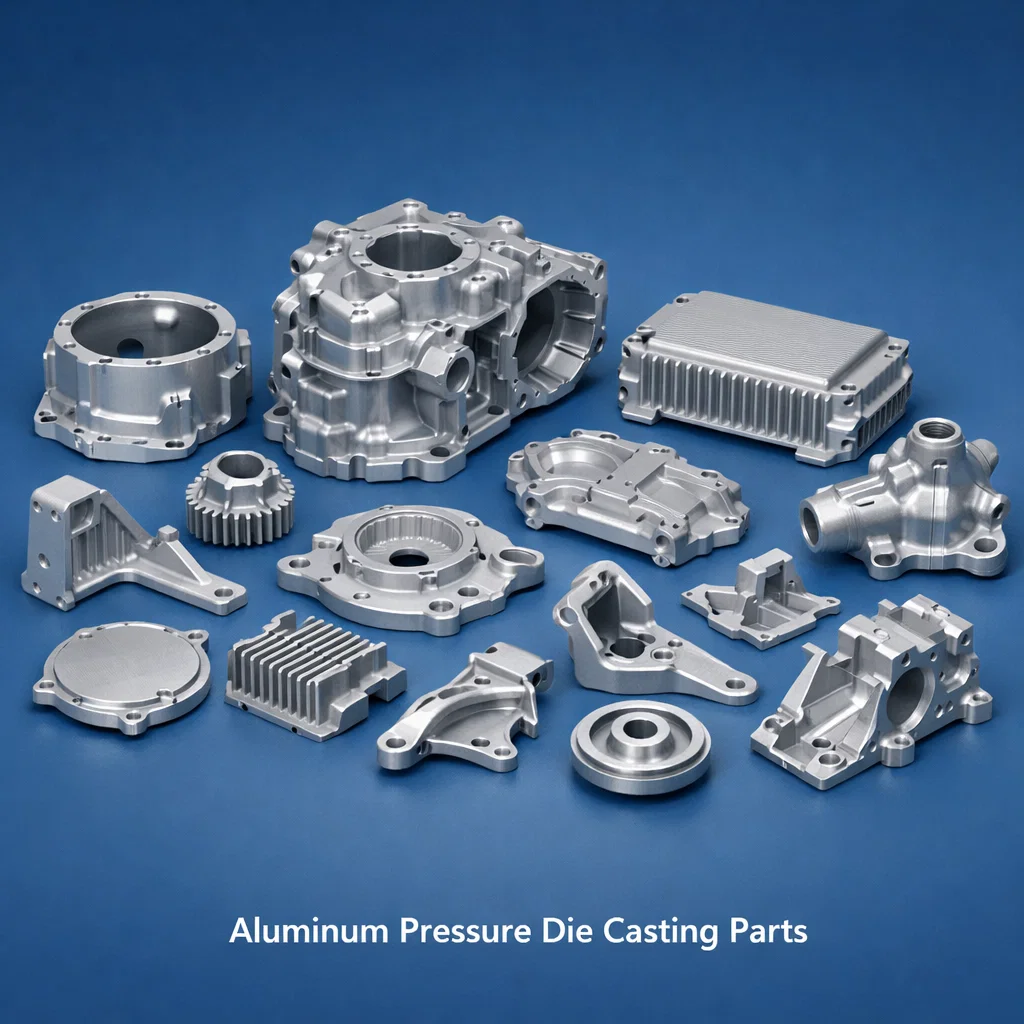
Aluminum Pressure Die Casting Parts
Aluminum pressure die casting (high-pressure die casting, HPDC) is a manufacturing process in which molten aluminum alloy is injected at high pressure (700–1,000 bar) and high velocity into a precision steel die cavity, solidifying in 1–30 seconds to produce complex, thin-walled aluminum parts with excellent dimensional accuracy, fine surface finish, and high production rates. Aluminum HPDC is the dominant process for high-volume aluminum component production in automotive, electrical, electronics, HVAC, industrial machinery, and consumer product sectors. Brass & Copper Parts manufactures aluminum pressure die casting parts in alloys ADC12 (A380), A360, A413, LM6, and LM24 for customers requiring cost-effective, dimensionally precise aluminum components in quantities from 1,000 to millions of pieces per year.
Product Overview
High-pressure die casting of aluminum combines the fluidity of aluminum alloys at moderate temperatures (620–720°C pouring temperature) with the precision of hardened steel die tooling to produce components with dimensional tolerances of CT3–CT5 (ISO 8062-3), surface finish Ra 0.8–3.2 μm as-cast, and wall thicknesses as thin as 1.0 mm. Aluminum HPDC offers the lowest per-piece cost of any near-net-shape aluminum casting process for volumes above 10,000 pieces per year, due to the combination of fast cycle times (15–120 seconds), multi-cavity tooling, and minimal secondary machining. Brass & Copper Parts produces aluminum HPDC parts in die casting machines with 125–1,600 tonne locking force, accommodating casting projections from 10 cm² to 500 cm² for components from 5 grams to 5 kilograms.
Key Features
- High dimensional accuracy – CT3–CT5 tolerance, tight part-to-part repeatability for automated assembly
- Excellent surface finish – Ra 0.8–3.2 μm as-cast; suitable for direct painting, plating, or powder coating
- Thin wall capability – Walls as thin as 1.0–1.5 mm for weight-critical components
- High production rate – 100–600 shots/hour depending on component size
- Multi-cavity tooling – 2, 4, 8 cavities per die for maximum output efficiency
- Good strength-to-weight ratio – Aluminum HPDC parts lighter than equivalent steel, brass, or iron components
- Near-net-shape efficiency – Minimal secondary machining reduces total manufacturing cost
Technical Specifications
| Property | ADC12 / A380 | A360 | A413 |
|---|---|---|---|
| Silicon (%) | 9.6–12.0 | 9.0–10.0 | 11.0–13.0 |
| Copper (%) | 1.5–3.5 | 0.6 max | 1.0 max |
| Iron (%) | 1.3 max | 2.0 max | 2.0 max |
| Tensile Strength (MPa) | 310–330 | 295–310 | 290–310 |
| Yield Strength (MPa) | 155–170 | 165–185 | 145–165 |
| Elongation (%) | 1.5–3.5 | 3.0–5.0 | 3.5–5.5 |
| Hardness (HB) | 75–90 | 70–85 | 70–85 |
| Density (g/cm³) | 2.71 | 2.63 | 2.66 |
| Die Casting Tolerance | CT3–CT5 | CT3–CT5 | CT3–CT5 |
International Grade Equivalents
| ASTM/AA | ADC (Japan) | EN 1706 | BS 1490 | IS 617 |
|---|---|---|---|---|
| A380 | ADC10 | EN AC-46000 | LM24 | – |
| A360 | ADC3 | EN AC-43400 | LM9 | – |
| A413 | ADC12 | EN AC-47100 | LM20 | – |
| A413.1 (LF) | ADC12 mod. | EN AC-47100 | LM20 | – |
Product Types and Variants
Aluminum HPDC Automotive Components
Engine mounts, transmission housings, throttle body castings, sensor brackets, gearbox covers, and structural crossmembers in A380 (ADC10) and A360 aluminum are high-pressure die cast for automotive OEM and tier-1 supplier applications requiring tight dimensional tolerances (CT3–CT4), consistent wall thickness (1.5–4 mm), and high production rates for JIT assembly supply chains. Brass & Copper Parts produces automotive aluminum HPDC components to IATF 16949 quality requirements, with PPAP Level 3 documentation, control plans, FMEA, and dimensional inspection reports for new part introductions. Shot monitoring, SPC on critical dimensions, and automated vision inspection are implemented on automotive production parts.
Aluminum HPDC Electrical and Electronics Enclosures
Electronic control unit (ECU) housings, motor frames, LED light housings, heat sinks, connector shells, and distribution board enclosures in A380 or A413 aluminum are die cast with integral heat dissipation fins, cable entry bosses, and mounting provisions in a single casting operation. Aluminum HPDC provides the combination of electromagnetic shielding (electrical conductivity), thermal conductivity (100–120 W/m·K for A380), corrosion resistance, and dimensional precision required for precision electronics enclosures. IP67/IP68 sealing compatibility is achieved through precise die-cast flange faces with O-ring grooves machined post-casting. Brass & Copper Parts produces electrical aluminum HPDC enclosures to IEC 60529 sealing requirements on request.
Aluminum HPDC HVAC and Compressor Components
Scroll compressor housings, heat pump manifolds, refrigerant valve bodies, and air conditioning bracket components in A380 die cast aluminum are high-volume precision parts where dimensional consistency affects refrigerant seal integrity and compressor efficiency. Aluminum HPDC compressor housings require flatness of ±0.05 mm on gasket sealing surfaces and bore diameter tolerances of ±0.03 mm after CNC finish boring — achievable from HPDC blanks with controlled casting shrinkage and consistent die temperature management. Brass & Copper Parts has experience in HPDC aluminum compressor and HVAC components for appliance OEM and commercial refrigeration equipment manufacturers.
Aluminum HPDC Structural Components
Structural brackets, chassis nodes, door handle bezels, handle bodies, window regulator brackets, and instrument panel components in A380 aluminum HPDC provide high strength-to-weight ratio (UTS/density ~115 MPa·cm³/g) in complex geometries unachievable by forging or fabrication at comparable cost. Structural aluminum HPDC components may require T6 heat treatment (solution anneal + age harden) where ductility or fatigue strength requirements exceed as-cast capabilities, accepting a slight dimensional relaxation from the HT cycle. Brass & Copper Parts applies vacuum-assisted die casting (VADC) for structural components where reduced porosity is required for heat treatment and improved mechanical properties.
Aluminum HPDC Industrial and Pump Components
Pump housings, impeller bodies, valve actuator bodies, solenoid valve frames, and hydraulic manifold blocks in aluminum A380/A360 are produced by HPDC for industrial machinery, process equipment, and fluid system applications. Aluminum HPDC pump components are significantly lighter than equivalent bronze or iron castings, reducing equipment weight for mobile plant and portable industrial equipment. For applications requiring corrosion resistance in acidic or chloride-containing process fluids, post-casting hard anodizing (type III) or electroless nickel plating of internal passages is available. Brass & Copper Parts produces industrial aluminum HPDC components with CNC machining of all critical bore, face, and thread dimensions in-house.
Aluminum HPDC Decorative and Consumer Product Parts
Door hardware, furniture fittings, tap handles, shower column bodies, architectural hardware, and consumer electronic device frames in A380 or low-iron A360 aluminum are produced by HPDC with excellent cosmetic surface quality (Ra 0.8–1.6 μm), suitable for direct decorative plating (chrome, nickel, satin), powder coat painting, or tumble polishing. Cosmetic aluminum HPDC castings require careful die surface preparation, controlled release agent application, and optimized injection parameters to minimize cold shuts, flow lines, and surface porosity. Brass & Copper Parts produces consumer and architectural aluminum HPDC castings for European and Australian decorative hardware markets with surface quality pre-approved by OEM customers prior to production launch.
Applications by Industry
| Industry | Aluminum HPDC Components |
|---|---|
| Automotive | Engine mounts, transmission cases, sensor brackets, structural nodes |
| Electrical/Electronics | ECU housings, motor frames, heat sinks, LED enclosures, connector bodies |
| HVAC & Refrigeration | Compressor housings, manifold blocks, heat exchanger headers |
| Industrial Machinery | Pump housings, hydraulic manifolds, solenoid valve bodies, actuator frames |
| Consumer Products | Door hardware, tap handles, shower components, furniture fittings |
| Telecommunications | Base station enclosures, antenna housings, heat sink frames |
Manufacturing Process
Aluminum HPDC at Brass & Copper Parts uses hot-chamber machines for low-melting-point alloys and cold-chamber machines (125–1,600 tonne) for standard aluminum alloys. Aluminum is melted in gas-fired or electric resistance furnaces at 660–720°C, degassed using rotary degassing with argon, and analyzed by OES spectrometer before transfer to the die casting machine holding furnace. The die casting cycle: die close → plunger advances → metal injection at 700–1,000 bar → solidification in die (1–30 sec) → die opens → ejector pins remove casting → cycle repeat. Trimming, shot blasting, X-ray (sampling or 100% for critical parts), dimensional gauging, CNC machining (where specified), and surface treatment complete the production flow. First-shot-off inspection and 100% functional gauging are standard for new part introductions.
Quality Standards and Certifications
- ASTM B85 – Standard specification for aluminum alloy die castings
- EN 1706 – European aluminum casting alloy standard
- ISO 8062-3 – Dimensional tolerances CT3–CT5
- IATF 16949 – Automotive quality management (aligned)
- ISO 9001:2015 – Quality management system
- RoHS / REACH – Compliance for EU market aluminum HPDC
- EN 10204 Type 2.2 – Material test report with every shipment
Why Choose Brass & Copper Parts
Brass & Copper Parts brings automotive-grade quality discipline to industrial and commercial aluminum HPDC production. Our die casting machines range from 125 to 1,600 tonne, covering the full range of small-to-large aluminum components in a single facility. In-house die design (using MAGMASOFT flow simulation) and die manufacturing from P20 and H13 steel ensures optimized gating, venting, and cooling for minimum porosity and maximum die life. SPC is implemented on critical casting dimensions, with real-time machine parameter monitoring and shot-to-shot process documentation. CNC machining, surface treatment, and full inspection under one roof simplifies supply chain management for OEM customers.
Frequently Asked Questions
What is the difference between cold chamber and hot chamber aluminum die casting?
Hot chamber die casting: the injection cylinder (gooseneck) is submerged in the molten metal holding pot — suitable only for low-melting alloys (zinc, magnesium, tin). Not used for aluminum because aluminum attacks the iron gooseneck at process temperatures. Cold chamber die casting: metal is ladled from a separate holding furnace into the injection sleeve for each shot — used for all aluminum alloys because the injection cylinder is not submerged in molten metal. All aluminum HPDC uses the cold chamber process.
Can aluminum HPDC castings be anodized?
Yes, but with limitations. High-iron alloys (A380/ADC10 with >1.3% Fe) anodize to limited depth (10–15 μm typical) and produce uneven anodic coating due to iron intermetallics. Low-iron/high-silicon alloys (A360, ADC3) anodize more uniformly. For decorative anodizing (Type II) or hard anodizing (Type III), low-silicon aluminum alloys (6061, 5052) in wrought form are preferred. For aluminum HPDC components requiring hard anodizing for wear resistance, specifying A360 (low copper, lower iron) improves anodizing quality. Brass & Copper Parts recommends alloy selection consultation for anodized HPDC applications.
What causes porosity in aluminum HPDC and how is it minimized?
Two types of porosity occur in aluminum HPDC: (1) Gas porosity — from hydrogen dissolved in molten aluminum, released during solidification; minimized by rotary degassing, low-hydrogen furnace atmosphere, and optimized injection speed. (2) Shrinkage porosity — from solidification contraction; minimized by optimized gating, intensification pressure after injection, and die cooling circuit design. Vacuum-assisted die casting (VADC) evacuates the die cavity before injection, reducing both gas and shrinkage porosity, enabling T6 heat treatment of structural HPDC components.
What is the minimum wall thickness for aluminum HPDC?
Minimum wall thickness of 1.0–1.5 mm is achievable for short flow length sections in aluminum HPDC. For larger components (above 200 mm flow length), minimum wall increases to 1.5–2.0 mm. Nominal recommended wall thickness for balanced structural and cosmetic requirements is 2.0–4.0 mm. Very thin walls (<1.5 mm) require high injection velocity, fine die venting, and die temperature optimization to prevent premature solidification (misrun/cold shut) before cavity fill is complete.
What is the typical tooling lead time for aluminum HPDC?
Single-cavity aluminum HPDC die: 6–10 weeks manufacture. Multi-cavity die (4–8 cavity): 8–14 weeks. First samples: 1–2 weeks after tooling completion. Total from drawing approval to first production samples: 8–16 weeks depending on complexity. Die material: H13 tool steel (standard) or premium-grade H13 for long-run automotive tooling. Brass & Copper Parts provides concurrent die design and manufacturing to reduce total tooling lead time.
What post-casting secondary operations are available?
Brass & Copper Parts offers: CNC turning, milling, drilling, and tapping (in-house); shot/tumble blasting; powder coat painting; wet paint; electroless nickel plating; hard anodizing (Type III); chrome plating; ultrasonic cleaning; pressure testing (air leak test, hydrostatic); X-ray inspection; CMM dimensional inspection; and pack and label for JIT automotive and electronics delivery. Component assembly (insert pressing, threaded insert installation, rubber seal fitting) is also available for kit supply.
Request a Quote
Brass & Copper Parts produces aluminum pressure die casting (HPDC) parts in A380, A360, A413, LM6, LM24, and custom alloys for automotive, electrical, HVAC, industrial, and consumer product applications. Submit drawings, volumes, and surface finish requirements for competitive tooling and per-piece pricing.
Contact us: sales@brass-copper-parts.com | +91-22-43449300
Product categories
Related Products
-

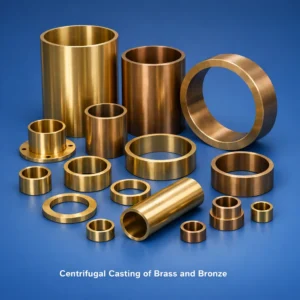
Centrifugal Casting of Brass and Bronze
₹13.40 Add to cart -
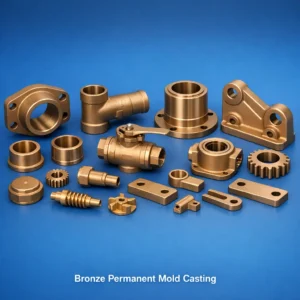
Bronze Permanent Mold Casting
₹13.40 Add to cart -
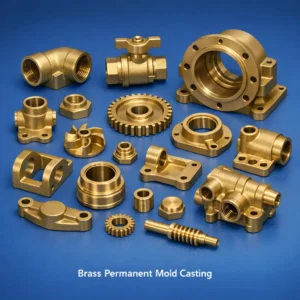
Brass Permanent Mold Casting
₹11.80 Add to cart -
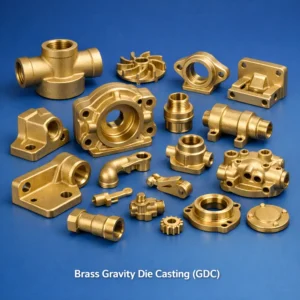
Brass Gravity Die Casting GDC
₹11.80 Add to cart -
Stainless Steel 304 and 316 Sand Casting
₹8.90 Add to cart -
Stainless Steel Investment Casting
₹8.90 Add to cart -
Aluminum Bronze Investment Casting
₹8.70 Add to cart -
Bronze Shell Molding, Shell Casting
₹13.40 Add to cart -
Gunmetal Casting Foundry
₹13.40 Add to cart -
83600 Bronze Casting, CDA 836 Bronze Casting
₹13.40 Add to cart -
LG2 Bronze Casting 85-5-5-5
₹13.40 Add to cart -
Phosphor Bronze Casting
₹13.40 Add to cart -
Lead Free Brass Casting
₹11.80 Add to cart -
Aluminum Bronze Casting
₹8.70 Add to cart