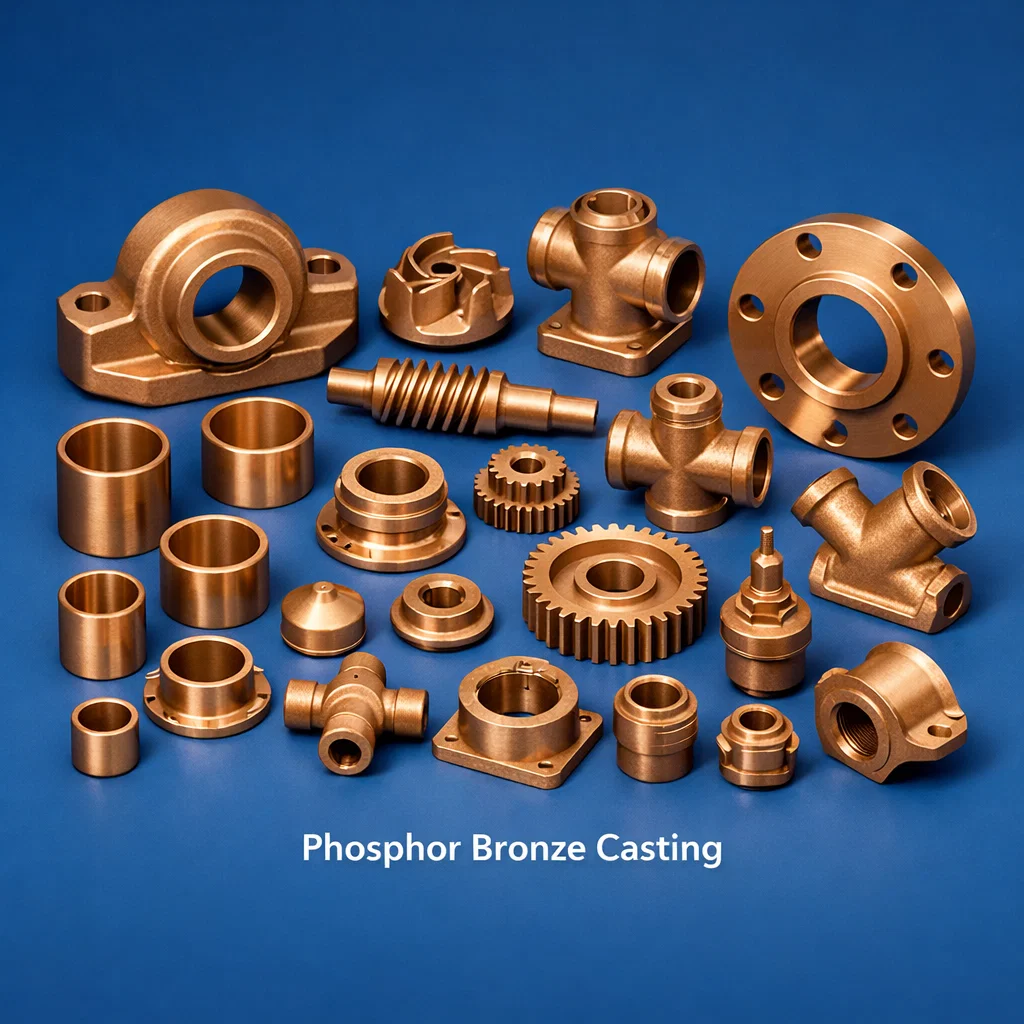
Phosphor Bronze Casting
Phosphor bronze casting refers to copper-tin-phosphorus alloy castings containing 5–12% tin with 0.01–0.40% phosphorus as a deoxidizing and strengthening agent. The phosphorus addition improves casting fluidity, refines grain structure, and enhances wear resistance compared to standard tin bronze alloys. Phosphor bronze castings exhibit outstanding bearing properties, fatigue resistance, spring properties in wrought form, and corrosion resistance in seawater, industrial chemicals, and atmospheric environments. Brass & Copper Parts manufactures phosphor bronze castings in grades C90300, C90500, C90700, C91100, and equivalent international grades for bearing, gear, marine, electrical, and precision engineering applications across global markets.
Product Overview
Phosphor bronze alloys (Cu-Sn-P) are among the oldest engineering alloys, valued for their predictable metallurgical behavior and established track record in demanding tribological and marine applications. The tin content in cast phosphor bronze ranges from 5% (C90300) to 12% (C91100), with higher tin content delivering greater hardness and wear resistance at the cost of reduced ductility. Phosphorus content of 0.01–0.40% serves as a deoxidizer during melting and contributes to fine dendritic grain structure in the as-cast condition. Brass & Copper Parts produces phosphor bronze castings in sand cast, centrifugal cast, continuous cast, and investment cast forms, with components ranging from sub-kilogram bearing inserts to multi-hundred kilogram gear blanks and worm wheels.
Key Features
- Excellent bearing properties – Low coefficient of friction, good compatibility with steel shafts
- High wear and abrasion resistance – Suitable for heavily loaded sliding and rotating contacts
- Good corrosion resistance – Resistant to seawater, industrial chemicals, and steam
- Good fatigue resistance – Suitable for oscillating and cyclic load applications
- Good castability – Excellent fluidity enables thin-walled and complex casting sections
- Non-magnetic properties – Suitable for use in magnetic field-sensitive equipment
- Good machinability post-casting – Enables precision finishing to close tolerances
Technical Specifications
| Property | C90300 (5% Sn) | C90500 (10% Sn) | C90700 (12% Sn) | C91100 (16% Sn) |
|---|---|---|---|---|
| Copper (%) | 86.0–89.0 | 86.0–89.0 | 86.0–89.0 | 83.0–86.0 |
| Tin (%) | 7.5–9.0 | 9.0–11.0 | 11.0–13.0 | 15.0–17.0 |
| Zinc (%) | 3.0–5.0 | 1.0–3.0 | 0.5 max | 0.25 max |
| Lead (%) | 0.30 max | 0.30 max | 0.50 max | 0.50 max |
| Phosphorus (%) | 0.05 max | 0.05 max | 0.10–0.40 | 0.10–0.40 |
| Tensile Strength (MPa) | 310 min | 310 min | 276 min | 241 min |
| Yield Strength (MPa) | 138 min | 138 min | 124 min | 103 min |
| Elongation (%) | 20 min | 20 min | 8 min | 5 min |
| Hardness (Brinell) | 65–85 HB | 70–90 HB | 80–110 HB | 90–120 HB |
| Density (g/cm³) | 8.77 | 8.70 | 8.65 | 8.54 |
International Grade Equivalents
| ASTM / CDA | BS 1400 | DIN 1705 | IS 318 | EN 1982 |
|---|---|---|---|---|
| C90300 | PB1 / CuSn8 | G-CuSn8 | Grade 3 | CC482K |
| C90500 | PB2 / CuSn10 | G-CuSn10 | Grade 2 | CC480K |
| C90700 | PB4 / CuSn12 | G-CuSn12 | Grade 1 | CC483K |
| C91100 | – | G-CuSn15 | – | – |
Product Types and Variants
Centrifugal Cast Phosphor Bronze Bushings
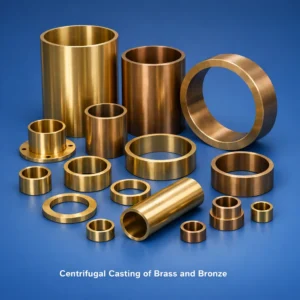
Centrifugal casting is the industry-standard process for producing phosphor bronze bushings, bearings, bearing rings, and sleeves. The centrifugal force densifies the casting, eliminating axial porosity and producing a fine, uniform grain structure with enhanced mechanical properties. Centrifugally cast phosphor bronze bushings conform to ASTM B505 and DIN 1705, in bore diameters from 20 mm to 800 mm and wall thicknesses from 5 mm to 100 mm. These bushings are used in crane hook blocks, hydraulic cylinder guide rings, pump shaft bearings, industrial gear housing bushings, and marine stern tube bearings. Brass & Copper Parts machines centrifugal cast bushings to H7/h6 tolerance fits as standard, with spiral lubrication grooves and oil holes per customer specification.
Sand Cast Phosphor Bronze Gear Blanks and Worm Wheels
Phosphor bronze C90700 and C91100 are the standard materials for worm wheel castings due to their high tin content providing excellent compatibility with hardened steel worm shafts. Sand cast phosphor bronze worm wheel blanks are produced in diameter from 100 mm to 1000 mm, with blank weight from 2 kg to 300 kg. These are supplied as rough castings or fully machined gears per customer drawings and tooth profiles (DIN 3975, AGMA, or customer specification). The high tin content (12–16%) creates a hard, wear-resistant bronze matrix that conforms to the steel worm profile under initial running-in, extending gear life significantly compared to cast iron or lower-grade bronze alternatives.
Phosphor Bronze Sand Castings for Marine Hardware
Marine applications require materials resistant to seawater corrosion, biofouling, and cavitation. Phosphor bronze C90300 and C90500 are widely specified for ship hardware including fairlead blocks, capstans, deck fittings, hawse pipes, chain stoppers, and bollard bases. These sand castings are produced to BS 1400 PB1/PB2 and ASTM B584 standards, with visual and dimensional inspection per applicable shipbuilding classification society requirements (DNV, Lloyd’s, BV, ABS). Wall thicknesses from 8 mm to 50 mm are standard for marine hardware; heavier sections are produced for mooring and anchor handling equipment subject to high shock loads.
Investment Cast Phosphor Bronze Precision Parts
Investment casting of phosphor bronze enables production of complex-geometry components with near-net-shape accuracy, eliminating or minimizing secondary machining. Precision phosphor bronze investment castings include valve internals, pump impellers, hydraulic manifold blocks, instrument housings, and electrical connector bodies. Surface finish of Ra 1.6–6.3 μm and dimensional tolerance CT5–CT7 (ISO 8062-3) are achievable without secondary finishing. This process is cost-effective for components with internal passageways, undercuts, or thin walls that are impractical to machine from bar stock. Brass & Copper Parts operates wax injection tooling and ceramic shell investment casting for phosphor bronze in batch sizes from 10 to 5,000 pieces.
Continuous Cast Phosphor Bronze Bars and Plates
Continuous cast phosphor bronze bars, rods, and plates provide a consistent, porosity-free semi-finished material for precision machining of bearings, bushings, wear plates, and custom components. Continuous cast phosphor bronze achieves superior density and mechanical property consistency compared to sand-cast billet due to controlled solidification conditions. Bars are produced in round diameters from 20 mm to 300 mm and plate/flat sections to 1000 mm width. Machinability is good for CNC turning, milling, and drilling operations. Brass & Copper Parts supplies continuous cast phosphor bronze as raw material (standard or custom lengths) or as finished machined components per customer drawings.
Phosphor Bronze Bearing Plates and Wear Liners
Flat phosphor bronze bearing plates, slide pads, and wear liners are used in steel plant continuous casting machines, bridge expansion joints, dam sluice gates, press platens, and machine tool slideways. These are produced from continuous cast or sand cast plate stock in dimensions from 100×100 mm to 1500×500 mm, with thickness from 10 mm to 100 mm. Graphite plugs (self-lubricating) or oil grooves are machined per design requirements to extend service life in applications where continuous lubrication is not practical. Tolerances on flatness are controlled to 0.1 mm/m or better for precision machinery applications.
Applications by Industry
| Industry | Typical Components |
|---|---|
| Power Transmission | Worm wheels, worm wheel blanks, helical gear bushings, cam followers |
| Marine & Shipbuilding | Stern tube bearings, propeller shaft bushings, deck hardware, fairleads |
| Heavy Engineering | Crane bushings, press tooling bearing plates, rolling mill guide liners |
| Oil & Gas | Pump bearings, downhole wear rings, gate valve seats, ROV components |
| Steel & Metallurgy | Continuous casting machine wear plates, slide bearings, guide pads |
| Electrical Engineering | Contact springs, relay components, transformer winding spacers, connector pins |
| Construction & Infrastructure | Bridge expansion bearings, dam gate seals, structural slide pads |
Manufacturing Process
Phosphor bronze castings are produced at Brass & Copper Parts using induction melting with controlled phosphorus deoxidation. Copper and tin are melted together at 1050–1100°C; phosphorus is added as copper-phosphorus master alloy (Cu-15%P) to achieve precise final phosphorus levels. Slag removal and temperature adjustment precede pouring. For centrifugal castings, horizontal or vertical centrifugal casting machines ensure uniform density from inner to outer diameter. For sand castings, pattern equipment produces cores for bearing bores and internal passageways. Post-casting operations include dimensional inspection, spectroscopic analysis, mechanical testing (per ASTM B584/B505), surface machining, and final inspection. All castings are identifiable by heat number for full material traceability.
Quality Standards and Certifications
- ASTM B584 – Sand castings for general applications
- ASTM B505 – Continuous cast copper alloy rod, bar, and tubes
- BS 1400 – PB1, PB2, PB4 phosphor bronze casting grades
- DIN 1705 – G-CuSn8, G-CuSn10, G-CuSn12 cast alloys
- IS 318 – Indian standard for tin bronze castings
- EN 1982 – CC480K, CC482K, CC483K European casting standards
- ISO 9001:2015 – Quality management system
- Classification Society approvals: DNV, Lloyd’s Register, BV, ABS (marine grade)
Why Choose Brass & Copper Parts
Brass & Copper Parts has extensive experience in phosphor bronze centrifugal casting and sand casting for global bearing, marine, and gear manufacturing customers. Our in-house centrifugal casting machines accommodate casting diameters up to 800 mm, and our pattern shop produces wooden and metal patterns for new components in-house, reducing tooling lead times. Mechanical testing including tensile, hardness, and impact testing is performed on each heat. We maintain stocks of standard phosphor bronze bushing sizes for fast delivery, and provide full machining capability for finished bearing components. Export shipments are supported by EN 10204 Type 3.1 material certificates, packing lists, and country of origin documentation.
Frequently Asked Questions
What is the difference between phosphor bronze and tin bronze?
Phosphor bronze is a tin bronze with intentional phosphorus addition (0.01–0.40%). Standard tin bronze has negligible phosphorus content. The phosphorus in phosphor bronze acts as a deoxidizer during casting, improving fluidity and casting soundness, and contributes to a harder, more wear-resistant microstructure (Cu3P phase). The terms are often used interchangeably in practice, but phosphor bronze specifically refers to alloys with deliberate phosphorus content.
Which phosphor bronze grade is best for worm gears?
C90700 (PB4, 12% tin) and C91100 (15–17% tin) are the preferred grades for worm wheel applications. Higher tin content produces a harder matrix with greater compatibility with the steel worm shaft during initial running-in wear. AGMA and ISO standards for worm gear design typically specify tin content of ≥10% for phosphor bronze worm wheels, with C90700/PB4 being the most widely used commercial grade.
What is the recommended shaft hardness for use with phosphor bronze bearings?
For optimal performance with phosphor bronze bearings (C90500/C90700), mating steel shafts should have a minimum surface hardness of 250 HV (approximately HRC 25), with 300–400 HV recommended for heavily loaded applications. Ground finish (Ra 0.4–0.8 μm) on the shaft journal minimizes running-in wear and extends bearing life. Nitrided or induction-hardened shaft surfaces are compatible with phosphor bronze bearings.
Can phosphor bronze castings be used in food processing equipment?
Standard phosphor bronze alloys contain up to 0.30–0.50% lead, which may not meet food contact material regulations. For food processing applications, lead free tin bronze (C90200 or equivalent) or stainless steel is recommended. If phosphor bronze is to be used in food-adjacent applications, compliance with relevant food safety regulations (EU 10/2011, FDA 21 CFR 175.300) should be verified for the specific alloy composition and application.
What is the load capacity of phosphor bronze bearings compared to white metal (babbitt)?
Phosphor bronze bearings have significantly higher load capacity and operating temperature range than white metal (babbitt) bearings. Phosphor bronze operates at pressures up to 70 MPa (C90700) versus 10–20 MPa for tin babbitt. Operating temperature capability is up to 250°C for phosphor bronze versus 100–120°C for white metal. However, babbitt provides better conformability and embeddability for dirty lubricant conditions. Phosphor bronze is preferred for high-load, clean-lubricant applications.
What is the minimum wall thickness achievable in phosphor bronze sand casting?
Minimum wall thickness in phosphor bronze sand casting is typically 4–6 mm for simple geometries and 6–10 mm for complex sections. Investment casting allows thinner walls of 2–3 mm for appropriate alloy grades. Very thin sections (<3 mm) are better produced by wrought (strip/sheet) or precision machining routes rather than casting.
Do you supply graphite-plug phosphor bronze bearings?
Yes. Brass & Copper Parts machines graphite plug inserts into centrifugal cast phosphor bronze bearing plates and bushings for self-lubricating applications including crane hooks, bridge bearings, and food machinery where oil lubrication is impractical or contaminating. Graphite plug pattern, size, and coverage density are specified per load, speed, and application parameters. This combination provides a PV value intermediate between oil-lubricated and dry running PTFE bearings.
How do I specify a phosphor bronze casting order?
To specify a phosphor bronze casting, provide: alloy grade (C90300/C90500/C90700 or equivalent BS/DIN), casting process (sand/centrifugal/investment), component drawing with dimensions and tolerances, weight per piece, quantity required, required inspections and certifications, and delivery requirement. For repeat components, previously approved sample or first article inspection (FAI) documents can be referenced. Brass & Copper Parts assigns a technical engineer to each casting project for drawing review and process feasibility confirmation before order acknowledgment.
Request a Quote
Brass & Copper Parts manufactures phosphor bronze castings in all standard and custom alloy grades for bearing, gear, marine, and precision engineering applications. Share your technical drawings and specifications with our engineering team for a prompt quotation with full certification support.
Contact us: sales@brass-copper-parts.com | +91-22-43449300
Product categories
Related Products
-

Centrifugal Casting of Brass and Bronze
₹13.40 Add to cart -
Aluminum Pressure Die Casting Parts
₹8.70 Add to cart -
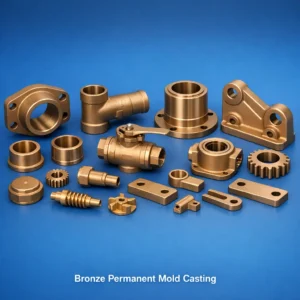
Bronze Permanent Mold Casting
₹13.40 Add to cart -
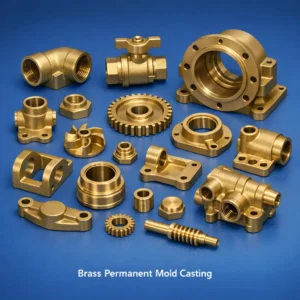
Brass Permanent Mold Casting
₹11.80 Add to cart -
Brass Gravity Die Casting GDC
₹11.80 Add to cart -
Stainless Steel 304 and 316 Sand Casting
₹8.90 Add to cart -
Stainless Steel Investment Casting
₹8.90 Add to cart -
Aluminum Bronze Investment Casting
₹8.70 Add to cart -
Bronze Shell Molding, Shell Casting
₹13.40 Add to cart -
Gunmetal Casting Foundry
₹13.40 Add to cart -
83600 Bronze Casting, CDA 836 Bronze Casting
₹13.40 Add to cart -
LG2 Bronze Casting 85-5-5-5
₹13.40 Add to cart -
Lead Free Brass Casting
₹11.80 Add to cart -
Aluminum Bronze Casting
₹8.70 Add to cart