
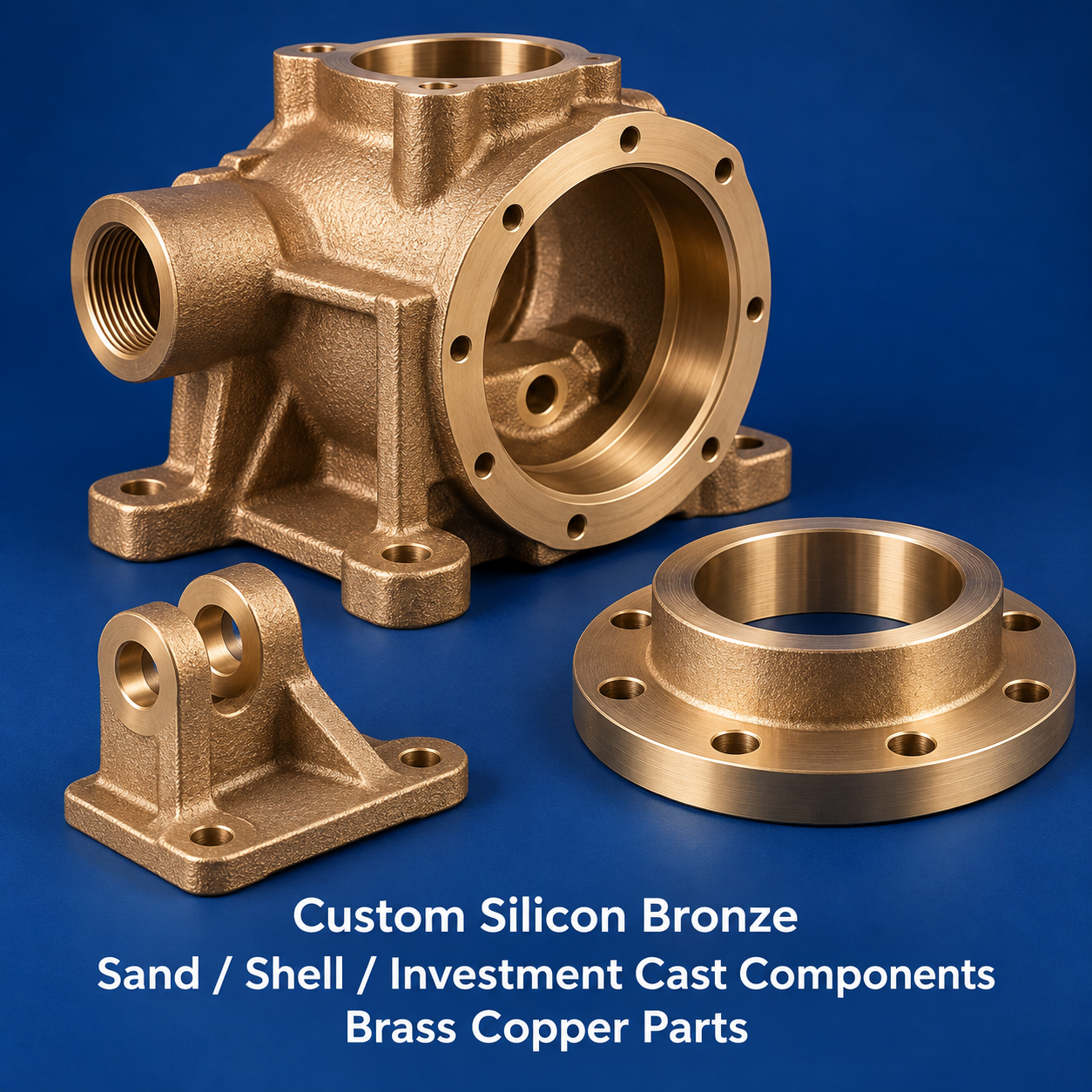
Custom Silicon Bronze Cast Components Made to Drawing
Brass Copper Parts supplies Custom Silicon Bronze Sand / Shell / Investment Cast Components for industrial equipment, pump and valve assemblies, architectural hardware and bespoke engineering applications. Submit your geometry and service requirements for alloy selection, casting-process review and machining planning.
Indicative price: US$ 17.80/kg. Each quotation defines the casting weight basis, tooling and finishing scope.
Choose the Casting Process Around the Component
| Process | How it works | Points to review |
|---|---|---|
| Sand casting | Metal fills a shaped sand mold, with cores where internal cavities are required. | Parting line, draft, core support, section transitions and machining stock. |
| Shell molding | A resin-bonded sand shell is formed around a heated pattern. | Repeat volume, pattern cost, wall geometry and required surface consistency. |
| Investment casting | A disposable wax pattern is used to build a ceramic mold. | Fine detail, wax tooling, ceramic-shell access and removal, finishing allowances. |
Shell molding here means resin-coated sand shell casting. It is distinct from the ceramic shell used in investment casting. The best method depends on dimensions, complexity, annual demand and the total cost of machining and tooling.
Alloy and Drawing Requirements
Specify the complete alloy designation and applicable material standard. C87300, C87500, C87600 and C87800 differ in chemistry and process-specific properties. C95600 is a silicon-containing aluminum bronze and requires a separate material review. These grades should not be treated as interchangeable.
- Provide a dimensioned drawing with revision, units and functional datums.
- Identify pressure boundaries, sealing surfaces, critical fits and threaded features.
- State as-cast and machined surface requirements separately.
- Include expected operating temperature, environment and mechanical loading.
- Confirm prototype quantity, batch volume and repeat-order expectations.
International Equivalent Grades for Custom Silicon Bronze Cast Components
Specify the original national standard and alloy grade with your drawing. The following references help organize an international material review; related grades are not automatically interchangeable.
| Requested grade | International designation or comparison | Equivalence status |
|---|---|---|
| C87300 | UNS C87300 / CDA 873; 95-1-4 silicon bronze | No exact EN, DIN, BS, JIS or GB equivalent verified here. |
| C87500 | EN CuZn16Si4-C (CC761S); older DIN GK-CuZn15Si4 (2.0492.02); Chinese ZCuZn16Si4 | Comparable silicon-brass grades; confirm full chemistry and properties. |
| C87600 | UNS C87600 / CDA 876; low-zinc silicon brass | No direct national-grade substitute verified here; higher-zinc grades require separate review. |
| C87800 | CuZn16Si4-C (CC761S) and ZCuZn16Si4 are related comparison grades | C87800 silicon and residual limits need individual comparison. |
| C95600 | UNS C95600 / CDA 956; historical ASTM Grade E silicon aluminum bronze | Separate aluminum-silicon alloy family; no direct EN, DIN, BS, JIS or GB equivalent verified here. |
Use the agreed specification edition and casting condition for acceptance. Supporting references: UNS cast-alloy tables, manufacturer DIN/EN comparison, CuZn16Si4 datasheet and historical ASTM Grade E reference.
Custom Casting Methods by Alloy Grade
Each alloy below has a separate paragraph for investment casting, green sand casting, permanent mold casting, shell molding / resin sand casting and die casting. Manufacturing feasibility and acceptance requirements are confirmed for the specified grade and component.
C87300 Custom Casting Methods
Silicon Bronze C87300 Investment Casting
Investment casting forms a ceramic mold around an expendable pattern and can reproduce detailed C87300 hardware, decorative contours and compact engineering shapes. Position gates away from important visible surfaces where practical. Specify the required texture, polishing allowance and machined interfaces so sample approval covers both appearance and fit.
Silicon Bronze C87300 Green Sand Casting
Green sand casting uses a reusable pattern with a fresh compacted sand mold for each pour. It is a practical route to review for C87300 brackets, housings and larger decorative forms. Pattern draft, core location and section transitions influence the result. Mark mounting holes and mating faces that will be machined after casting.
Silicon Bronze C87300 Permanent Mold Casting
A reusable metal mold can be considered for repeated C87300 parts with geometry suitable for mold opening and ejection. Gravity filling, mold temperature and protective coatings are developed around the section thickness. Review tooling cost against annual demand and approve initial castings before fixing the production dimensional and surface requirements.
Silicon Bronze C87300 Shell Molding – Resin Sand Casting
Shell molding uses resin-coated sand on a heated pattern, while resin sand molding can form a thicker chemically bonded mold. Both require review of binder selection, venting and core support. For C87300 fittings and hardware, agree parting-line locations, gate-removal areas and machining stock, particularly where the finished component will be polished.
C87300 Silicon Bronze Die Casting
High-pressure die casting needs a separate feasibility review for C87300. The CDA casting guide lists several routes for this grade but does not list pressure die casting among its standard applicable processes. If a die-cast component is required, confirm alloy and tooling compatibility with the foundry. Any proposed change to a silicon-brass die-casting grade requires purchaser approval.
C87500 Custom Casting Methods
Silicon Bronze C87500 Investment Casting
Investment casting can reproduce detailed C87500 impellers, levers and fittings using an expendable pattern and ceramic shell. The design review considers thin features, gate locations and access for shell removal. Identify passages requiring cleaning and faces needing machining; achievable wall thickness and finish are agreed for the actual component.
Silicon Bronze C87500 Green Sand Casting
Green sand molds offer a flexible route for C87500 valve bodies, housings and other cored shapes. Pattern layout and core support help establish passage alignment, while risers feed heavier sections during solidification. Specify minimum walls, flange allowances and testing requirements so casting and subsequent machining are planned together.
Silicon Bronze C87500 Permanent Mold Casting
Permanent mold casting fills a reusable metal tool, commonly under gravity. It can be assessed for repeat C87500 components whose shape permits release from the mold. Tool temperature, coating and filling sequence affect consistency. Compare tooling cost with production volume and agree dimensional inspection of first samples.
Silicon Bronze C87500 Shell Molding – Resin Sand Casting
Resin-coated shell molds can be considered for repeated C87500 fittings, while chemically bonded resin sand molds provide another option for larger or cored components. These processes need different pattern and mold arrangements. Review gas venting, core joints and sealing-face allowances before selecting the route and approving production samples.
C87500 Silicon Bronze Die Casting
Pressure die casting is a process option for C87500 silicon brass, subject to specialist copper-alloy equipment and part review. Injection into a reusable die can suit repeat production where tooling is justified. Discuss die life, draft, trimming and porosity acceptance. For fluid-handling parts, define leak testing and pressure requirements separately from general visual acceptance.
C87600 Custom Casting Methods
Silicon Bronze C87600 Investment Casting
Investment casting can be considered for C87600 fittings with complex outer profiles, small bosses and features that are costly to machine from solid stock. Expendable patterns allow detailed shapes, but internal cavities still need practical core and cleaning arrangements. Define datum faces, thread allowances and inspection access before selecting this route.
Silicon Bronze C87600 Green Sand Casting
Green sand casting provides a pattern-based route for C87600 housings, valve parts and larger fittings. Cores establish internal passages, and their support must maintain the specified minimum walls. Include machining stock on sealing faces and locate feeding features around heavy sections. Pressure testing, where required, belongs in the purchase specification.
Silicon Bronze C87600 Permanent Mold Casting
Permanent mold casting may be assessed for repeat C87600 parts with relatively straightforward release geometry. Reusable metal tooling calls for controlled mold temperatures, coatings and filling practice. Consider annual demand, core requirements and ejection marks when comparing it with sand casting. Approve samples against the specified process condition and finished dimensions.
Silicon Bronze C87600 Shell Molding – Resin Sand Casting
Shell molding and resin-bonded sand casting offer alternative mold systems for C87600 engineering components. A thin resin-coated shell uses heated tooling; a chemically bonded mold can accommodate a different range of sizes and cores. Review binder gas, passage cleaning and core alignment, then agree the casting surface and machined tolerances separately.
C87600 Silicon Bronze Die Casting
C87600 can be considered for pressure die-casting enquiries using equipment suitable for copper alloys. Tooling feasibility depends on section thickness, projected area, cores and production quantity. Specify the allowed porosity, trimming condition and machining depth, particularly where machining could expose internal defects. Electrical fittings also need application-specific contact and mechanical acceptance requirements.
C87800 Custom Casting Methods
Silicon Bronze C87800 Investment Casting
Investment casting is an option to review when a C87800 component includes detailed contours or geometry that complicates die release. A ceramic shell is formed around an expendable pattern. Define the required casting condition and sample tests explicitly, since die-cast or permanent-mold property values cannot simply be assigned to investment-cast parts.
Silicon Bronze C87800 Green Sand Casting
Green sand casting can be evaluated for C87800 prototypes, larger shapes or components with cored passages. The pattern needs suitable draft, and the mold needs a feeding plan for thick bosses and junctions. Specify machining stock and surface requirements. Agree sand-cast acceptance values rather than transferring requirements from a different manufacturing route.
Silicon Bronze C87800 Permanent Mold Casting
Permanent mold casting is a relevant route for C87800 repeat hardware and fittings. Gravity-filled reusable tooling requires practical parting lines and controlled ejection. Discuss annual volume, mold maintenance and sample dimensions when developing the tool. State the applicable permanent-mold specification and the inspection needed on machined bores, threads and loaded transitions.
Silicon Bronze C87800 Shell Molding – Resin Sand Casting
Shell molding uses resin-coated sand with heated tooling; resin-bonded sand molds provide a separate option for larger or more heavily cored C87800 parts. Review core strength, gas escape and feeding before choosing either system. For clamps and brackets, mark loaded radii and machining datums so cleaning and finishing preserve the functional geometry.
C87800 Silicon Bronze Die Casting
C87800 is associated with pressure die casting, making this a key option for repeated copper-alloy hardware. The die design must accommodate filling, venting, release draft and trimming. Define allowed porosity and surface witness marks, especially near threads and sealing areas. The enquiry should include batch size and annual demand so tooling cost and inspection can be assessed.
C95600 Custom Casting Methods
Silicon Bronze C95600 Investment Casting
Investment casting uses an expendable pattern and ceramic mold to reproduce intricate contours. For C95600 valve details, hardware and gear blanks, the review should cover shell compatibility, metal cleanliness, feeding and removal of gates. Identify bores and working faces that need finish machining, together with the required surface finish and inspection access.
Silicon Bronze C95600 Green Sand Casting
Green sand casting forms the component in a compacted, moisture-bonded sand mold. It can be considered for C95600 blanks with geometry that allows practical pattern withdrawal and core placement. Mold moisture, venting and filling require careful control. Include machining stock on hubs, mating faces and bores, and identify thick sections where shrinkage must be managed.
Silicon Bronze C95600 Permanent Mold Casting
Permanent mold casting uses a reusable metal mold, usually filled by gravity. A C95600 proposal requires a specific assessment of mold material, protective coating, thermal cycling, filling and ejection. Repeated production may justify tooling, but suitability cannot be inferred from sand-cast properties. Agree process-specific samples and acceptance criteria before committing production tooling.
Silicon Bronze C95600 Shell Molding – Resin Sand Casting
Shell molding uses resin-coated sand against a heated pattern to produce a relatively thin mold shell. Resin sand casting can also use a thicker chemically bonded mold; the two routes have different tooling needs. For C95600 parts, review binder gas, core support and feeding around section changes. Define parting lines, machining datums and the required condition of visible surfaces.
C95600 Silicon Bronze Die Casting
High-pressure die casting injects metal into a reusable die and is different from gravity permanent mold casting. C95600 is not presented here as a routine high-pressure die-casting alloy. Enquiries require foundry confirmation of alloy compatibility, die life, filling and porosity control. Where this route cannot meet the drawing, request a sand, shell or investment-casting proposal using the specified C95600 material.
From Tooling Review to Finished Part
The production plan covers pattern or wax tooling, molding, alloy preparation, pouring, cleaning, finishing and inspection. Core placement, feeding and section transitions are reviewed around the actual drawing. Any design change requires agreement before it is incorporated into tooling.
Machined bores and mating faces need allowance and access for workholding. Where a feature is difficult to cast consistently, the review can consider forming a simpler near-net shape and machining the final detail. Dimensional and surface-finish commitments are set for the selected process and part geometry.
Drawing Review, Inspection and Quotation
Send your drawing or 3D model, alloy specification, quantity, finished part weight and delivery destination to Brass Copper Parts. Mark critical bores, threads, sealing faces, datum locations and surface finishes. Tooling cost and lead time are confirmed after review.
Specify heat traceability, chemical analysis, dimensional reporting and any mechanical or non-destructive testing in the enquiry. Sampling and acceptance criteria should be agreed before production. Certification, pressure ratings and service suitability depend on the specified component and inspection plan.
Price and Ordering Questions
How is the price calculated?
The indicative price is US$ 17.80/kg. The quotation defines billable weight and any tooling, machining, testing, packaging or freight charges.
Can castings be supplied machined?
Request the required bores, threads and finished faces on your drawing. Machining allowance and tolerances are agreed for each feature and casting route.
Build a Clear Casting Enquiry Package
Start with a dimensioned drawing and, where available, a 3D model. Include the revision, units, quantity and intended application. Mark the features that control assembly and distinguish the finished dimensions from the as-cast shape. This helps the review identify where casting detail is useful and where machining is needed.
For an early design, explain the features that can change and those that must remain fixed. Include mating-part information, access restrictions and appearance requirements. A process proposal can then address tooling, core geometry and finishing against the actual function of the component.
Compare Total Component Cost and Approval Stages
Compare sand, shell and investment casting proposals on the cost of the finished component. Tooling, cleaning, machining, inspection and batch size all belong in the comparison. A process with a different tooling cost may also change the amount of finishing required, so the scope should be consistent across options.
Set out the stages for drawing approval, tooling review, sample inspection and batch release. Define how changes will be recorded and which documents should accompany delivery. For repeat work, keep the approved drawing revision and inspection requirements with the order reference.
More Questions and Answers About Custom Silicon Bronze Components
Which process should I choose if my design is still developing?
Send the current drawing, anticipated changes and trial quantity. The review can consider how tooling and sample requirements fit the development stage before a process is agreed.
Are shell molding and investment casting the same process?
No. Shell molding here uses a resin-bonded sand shell, while investment casting uses a ceramic mold built around a disposable pattern. Specify which process you require or request a review.
Is a 3D model enough to request a quotation?
It helps describe shape, but a drawing or specification should also define material, tolerances, finish and inspection. Include quantity and application details with the model.
Can I request a comparison of casting methods?
Yes. Ask for feasible options against the same finished-part requirements and quantity. Compare tooling and recurring costs as well as machining and inspection scope.
How should prototype approval be handled?
Agree the sample quantity, measurements, appearance checks and documents before production. Record approval or requested changes against the drawing revision.
Can multiple part numbers be included in one enquiry?
Yes. List each part number, revision, alloy, quantity and finishing requirement separately. Identify common assembly features so related parts can be reviewed together.
Request a Quote for Custom Silicon Bronze Components
Ready to discuss your component? Send your drawing or model, material specification, quantity, required finish and delivery destination to Brass Copper Parts. Include your target delivery date and inspection requirements so the quotation can define tooling, machining and testing scope.
Email Your Drawing for a Quote | Request a Casting Review | Call +91-22-43449300
Explore Related Silicon Bronze Products
Compare alloy options within our Silicon Bronze Casting and Foundry range.