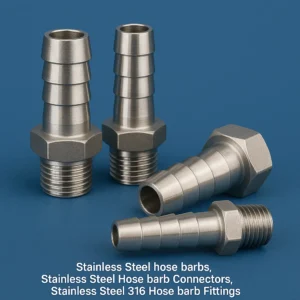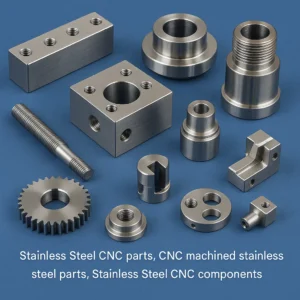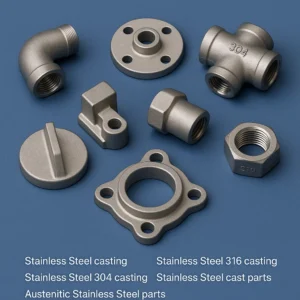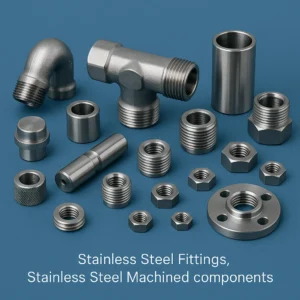
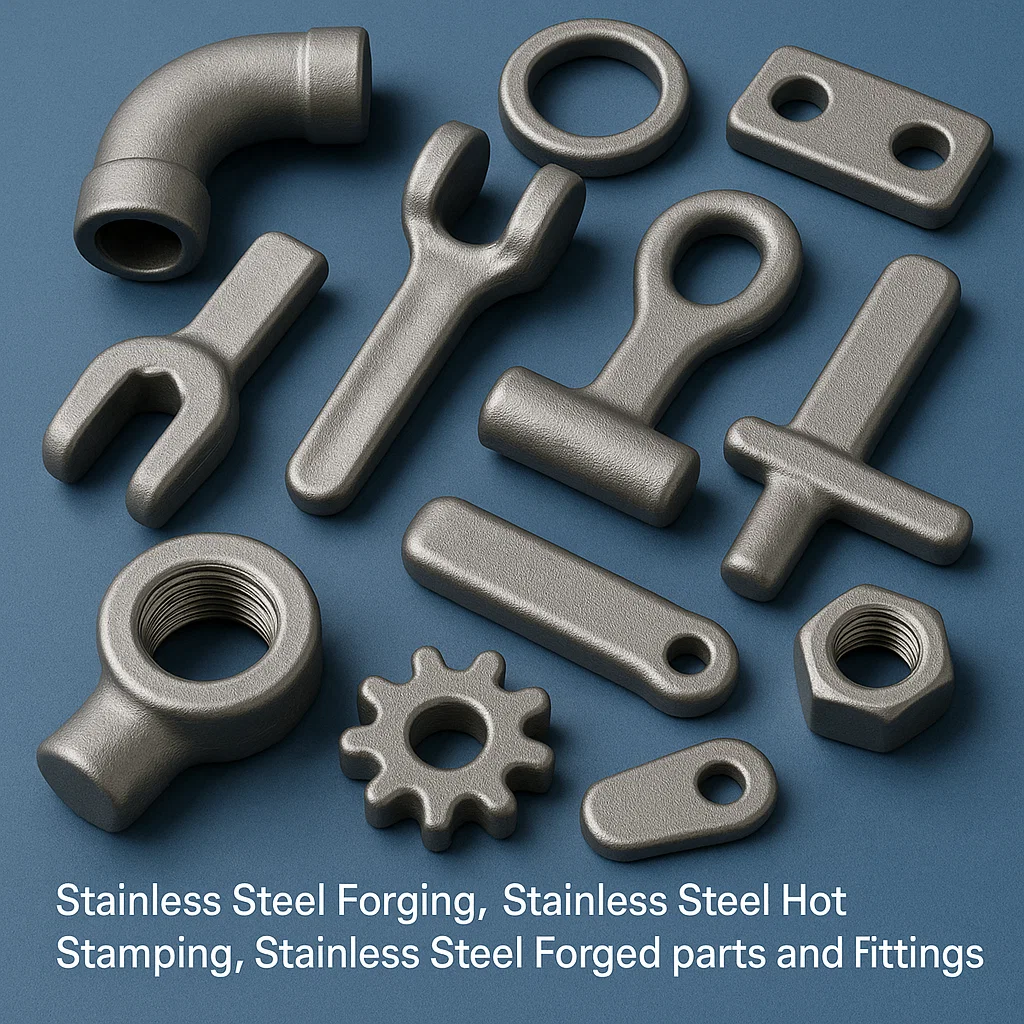
Stainless Steel Stamping, Stainless Steel 316 Stamped parts, Stainless Steel Hot Forging

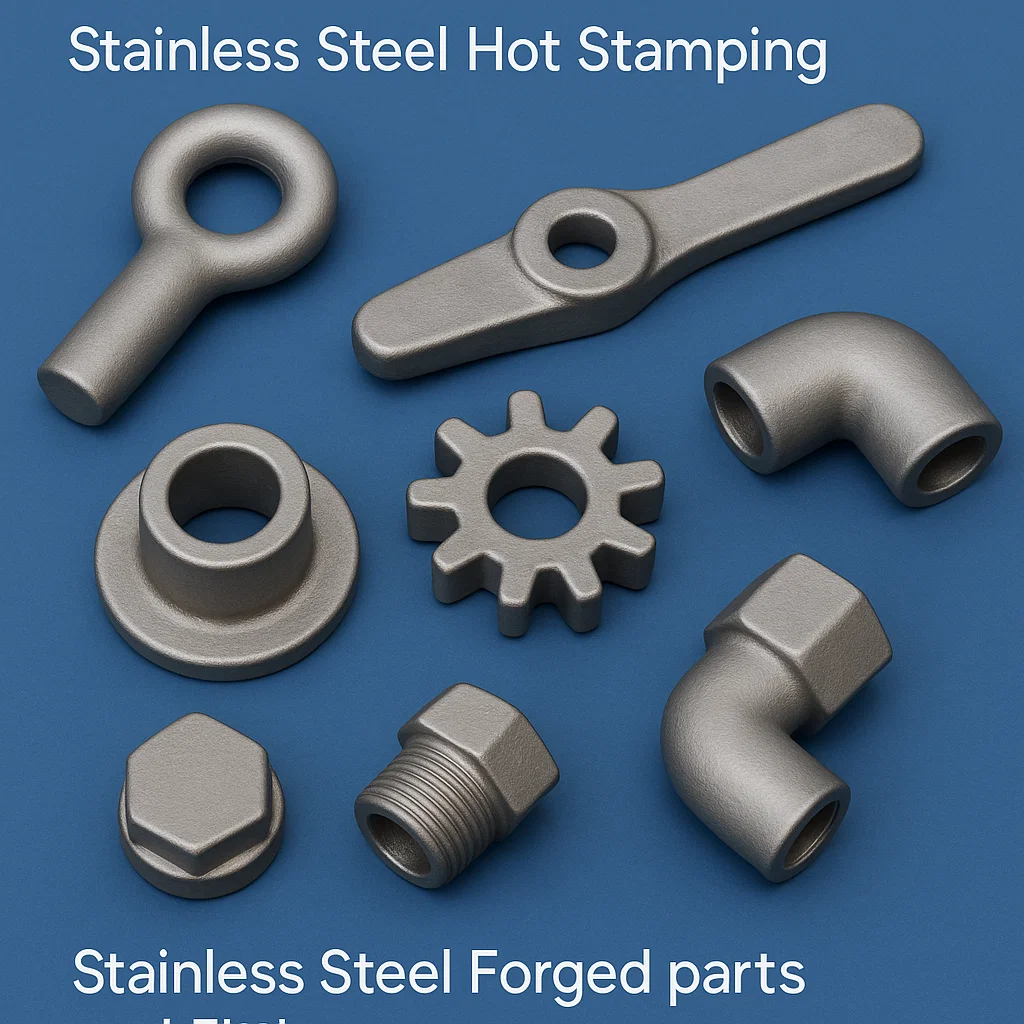
Stainless Steel Forging, Stamping & Precision Machined Components – Premium Quality Manufacturer & Exporter
We are one of the leading manufacturers and exporters of Stainless Steel Forging, Stainless Steel Stamping, Precision Forged Fittings, and CNC Machined Components from India. We have been supplying high-quality Stainless Steel forged and stamped parts to the world market for many decades. Our state-of-the-art manufacturing facility specializes in producing precision-engineered Stainless Steel components through advanced hot forging, cold stamping, and computer numerical control machining processes. With over three decades of global exposure and engineering excellence, we cater to diverse industrial applications requiring superior mechanical properties, corrosion resistance, and dimensional accuracy. Our comprehensive range includes Stainless Steel 304 forging, Stainless Steel 316 stamping, custom forged fittings, precision stamped parts, and complex CNC machined components manufactured to international quality standards including ASTM, DIN, BS, IS, and JIS specifications. We serve automotive, aerospace, oil and gas, marine, chemical processing, food processing, pharmaceutical, and construction industries worldwide with customized solutions, flexible production capabilities, and stringent quality control protocols ensuring consistent performance and reliability in demanding operational environments.
Comprehensive Overview of Stainless Steel Forging and Stamping Technologies
Stainless Steel forging and stamping represent two fundamental metalworking processes that transform raw Stainless Steel materials into high-performance engineered components with superior mechanical properties and dimensional precision. The forging process involves the application of compressive forces through hydraulic presses, mechanical hammers, or screw presses to plastically deform Stainless Steel billets, bars, or blanks at elevated temperatures (hot forging) or ambient temperatures (cold forging), resulting in refined grain structure, enhanced tensile strength, improved fatigue resistance, and elimination of internal porosity. Conversely, Stainless Steel stamping utilizes precision dies and punches mounted on mechanical or hydraulic presses to cut, form, bend, pierce, and emboss Stainless Steel sheets or strips into complex geometries with tight tolerances and excellent surface finish. Both processes leverage the inherent corrosion resistance, high temperature stability, and favorable work hardening characteristics of austenitic, ferritic, martensitic, and duplex Stainless Steel grades to produce critical components for challenging applications across multiple industrial sectors.
Our manufacturing capabilities encompass the complete spectrum of Stainless Steel forming technologies including closed die forging, open die forging, impression die forging, roll forging, precision stamping, progressive die stamping, deep drawing, fine blanking, and multi-stage forming operations combined with secondary machining, heat treatment, surface finishing, and quality inspection procedures. We maintain extensive inventory of premium Stainless Steel raw materials conforming to international specifications and employ advanced computer-aided design (CAD), computer-aided manufacturing (CAM), and finite element analysis (FEA) software to optimize die design, material flow, stress distribution, and dimensional accuracy before commencing production. Our integrated approach combines traditional metallurgical expertise with modern automation, robotics, and digital manufacturing technologies to deliver cost-effective solutions with consistent quality, shorter lead times, and superior technical support throughout the product development lifecycle.
Stainless Steel Forging encompasses the controlled plastic deformation of Stainless Steel alloys under compressive forces to produce components with exceptional mechanical integrity, directional grain flow, and enhanced structural properties compared to cast or machined alternatives. The forging process refines the microstructure of Stainless Steel by breaking down cast dendritic structures, eliminating segregation, closing internal voids, and aligning grain boundaries along the principal stress directions, thereby improving tensile strength, yield strength, impact toughness, fatigue endurance, and stress corrosion cracking resistance. Our Stainless Steel forging operations utilize precision drop hammers ranging from 500 kg to 5000 kg capacity, hydraulic forging presses from 1000 ton to 10000 ton capacity, mechanical forging presses, screw presses, and ring rolling mills equipped with induction heating furnaces, controlled atmosphere furnaces, and computer-controlled temperature monitoring systems to maintain optimal forging temperatures between 1050°C to 1250°C for austenitic grades and 900°C to 1150°C for martensitic grades. We produce forged components ranging from small precision fittings weighing 50 grams to large industrial forgings weighing several hundred kilograms with material utilization efficiency exceeding ninety percent through near-net-shape forging techniques.
Stainless Steel Stamping represents a high-speed, high-precision metal forming methodology that transforms Stainless Steel sheets, strips, and coils into flat or three-dimensional components through shearing, punching, blanking, bending, embossing, coining, and drawing operations performed on mechanical or hydraulic stamping presses. Our stamping facility operates multiple press lines ranging from 25 ton capacity gap frame presses for small precision parts to 500 ton capacity straight side presses for large structural components, all equipped with progressive dies, transfer dies, compound dies, and single-stage dies manufactured from hardened tool steels and tungsten carbide inserts to ensure extended tool life and consistent part quality. Stainless Steel stamping offers distinct advantages including rapid production rates exceeding several thousand parts per hour, excellent repeatability with tolerances down to ±0.05mm, minimal material waste through optimized nesting and blanking layouts, superior surface finish without secondary operations, and cost-effectiveness for medium to high volume production runs. We process Stainless Steel sheet materials from 0.3mm to 6mm thickness in coil or sheet form with capabilities for multi-slide forming, deep drawing with draw ratios up to 2.5:1, hydroforming, and rubber pad forming for complex contours and irregular shapes.
Stainless Steel 316 Stamping specifically addresses the fabrication requirements of marine, chemical processing, pharmaceutical, and food grade applications demanding superior corrosion resistance in chloride-rich, acidic, and high-temperature environments. Stainless Steel 316 (ASTM A240, DIN 1.4401, JIS SUS316, BS 316S31) contains molybdenum addition (2-3%) that significantly enhances pitting and crevice corrosion resistance compared to standard 304 grade, making it the preferred material for stamped components exposed to saltwater, chemical solutions, sterilization processes, and aggressive industrial atmospheres. Our Stainless Steel 316 stamping operations employ specialized tooling with polished die surfaces, controlled blank holding forces, and appropriate lubrication systems to accommodate the higher work hardening rate and lower formability characteristics of this molybdenum-bearing austenitic grade. We manufacture precision stamped parts including valve discs, filter screens, chemical tank components, marine hardware, pharmaceutical equipment parts, food processing elements, medical device housings, and architectural trim components from Stainless Steel 316 and 316L (low carbon variant) materials in annealed, half-hard, and full-hard temper conditions with thickness ranging from 0.5mm to 4mm and dimensional tolerances maintained within ±0.08mm for critical features.
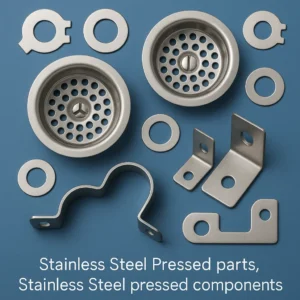
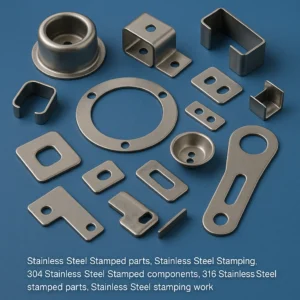
Stainless Steel Stamped Parts constitute a diverse product category encompassing thousands of unique component designs serving automotive, electronics, appliance, construction, aerospace, medical, and consumer goods industries with requirements spanning decorative trim, structural brackets, functional hardware, precision springs, electrical contacts, shielding enclosures, and specialized fasteners. Our stamped parts portfolio includes flat washers, lock washers, spring washers, retaining rings, circlips, E-clips, stamped terminals, electrical contacts, battery springs, compression springs, extension springs, torsion springs, automotive brackets, mounting clips, panel fasteners, decorative emblems, architectural hardware, electrical switchgear components, HVAC grilles, appliance panels, instrument bezels, medical device housings, and thousands of custom-designed parts manufactured according to customer specifications and drawings. We maintain comprehensive quality assurance protocols including first article inspection, in-process dimensional verification using coordinate measuring machines (CMM), optical comparators, and digital micrometers, statistical process control (SPC) monitoring, automated vision inspection systems, and final audit inspection with complete documentation and material test certificates traceable to heat numbers and mill certifications.
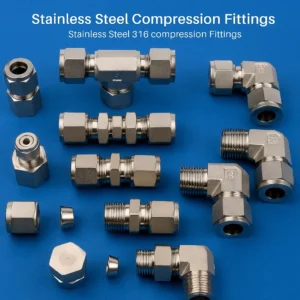
Stainless Steel Forged Fittings represent critical piping system components manufactured through hot or warm forging processes to achieve superior pressure rating, leak-tight performance, and extended service life in demanding fluid handling applications across oil and gas, petrochemical, power generation, marine, and process industries. Our forged fittings range includes elbows (45°, 90°, 180°), tees (equal and reducing), crosses, couplings (full and half), unions, caps, plugs, bushings, nipples, reducers (concentric and eccentric), swage nipples, hexagon nipples, barrel nipples, and specialty fittings conforming to ASME B16.11 (socket weld and threaded fittings), MSS-SP-79, MSS-SP-83, BS 3799, and DIN 2950 standards. We forge fittings from premium Stainless Steel grades including 304/304L (ASTM A182 F304/F304L), 316/316L (ASTM A182 F316/F316L), 321 (ASTM A182 F321), 347 (ASTM A182 F347), duplex 2205 (ASTM A182 F51), super duplex 2507 (ASTM A182 F53), and other special alloys in pressure classes 3000#, 6000#, and 9000# with sizes ranging from 1/8″ to 4″ nominal pipe size. Each forged fitting undergoes complete dimensional inspection, non-destructive testing including ultrasonic examination and liquid penetrant inspection, hydrostatic pressure testing, and material verification through positive material identification (PMI) analysis before shipment with comprehensive test reports and material certificates.
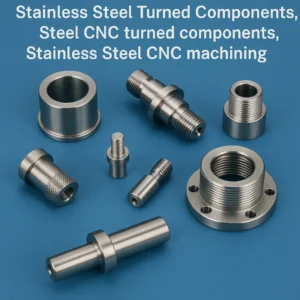
Stainless Steel Forged CNC Machined Components combine the structural integrity and metallurgical advantages of precision forging with the dimensional accuracy and complex geometric capabilities of computer numerical control machining to produce high-performance parts for aerospace, defense, automotive racing, industrial machinery, and specialized equipment applications. This hybrid manufacturing approach begins with near-net-shape forging operations that establish the basic component geometry, grain flow orientation, and mechanical property distribution, followed by precision CNC milling, turning, drilling, threading, and finishing operations that achieve final dimensional tolerances down to ±0.01mm, surface roughness values of Ra 0.4μm to 1.6μm, and intricate features including internal passages, threaded connections, precision bores, keyways, splines, and complex contoured surfaces. Our CNC machining center fleet includes 3-axis, 4-axis, and 5-axis vertical and horizontal machining centers, CNC turning centers with live tooling and sub-spindle capabilities, Swiss-type automatic lathes for small precision components, and electrical discharge machining (EDM) equipment for hardened materials and complex cavity shapes. We manufacture forged and CNC machined components such as hydraulic valve bodies, pump housings, compressor components, turbine parts, automotive suspension elements, precision shafts, coupling assemblies, gear blanks, flange assemblies, and custom engineered parts with complete documentation including first article inspection reports, material certificates, dimensional inspection data, and process capability studies.
Stainless Steel Forged and CNC Machined Parts represent the pinnacle of precision component manufacturing where the synergistic combination of thermomechanical processing and advanced subtractive machining delivers components with optimal material properties, geometric complexity, and functional performance characteristics unattainable through either process alone. The integration of forging and CNC machining enables the production of components with strategically positioned thick and thin sections, variable cross-sectional profiles, internal cavities, precision holes with tight positional tolerances, threaded connections conforming to metric, unified, or specialty thread standards, and surface finish specifications ranging from as-forged conditions to mirror-polished surfaces depending on application requirements. Our engineering team collaborates with customers during the design phase to optimize part geometry for forgeability, minimize machining allowances, reduce material waste, eliminate unnecessary features, consolidate multiple parts into single-piece designs, and incorporate design-for-manufacturing (DFM) principles that reduce production costs while maintaining or enhancing functional performance. We routinely manufacture complex forged and machined assemblies including valve bodies with internal flow passages, pump housings with precision bearing journals, manifold blocks with intersecting fluid passages, hydraulic cylinders with chrome-plated bores, gear housings with integral mounting flanges, and specialized components with geometric tolerances specified per ASME Y14.5 standards including perpendicularity, parallelism, concentricity, and positional accuracy requirements.
Stainless Steel 304 Forging leverages the most widely utilized austenitic Stainless Steel grade (ASTM A276/A479 304, DIN 1.4301, JIS SUS304, BS 304S15) offering excellent corrosion resistance, superior formability, and favorable mechanical properties for general-purpose forging applications across food processing, architectural, dairy, brewery, chemical, and general industrial sectors. Stainless Steel 304 contains 18% chromium and 8% nickel in a stable austenitic matrix that exhibits exceptional ductility, enabling significant plastic deformation during hot forging operations at temperatures between 1050°C to 1200°C without cracking or surface defects. Our Stainless Steel 304 forging capabilities produce components with tensile strength ranging from 515 MPa to 720 MPa, yield strength of 205 MPa to 380 MPa depending on cold work and heat treatment conditions, elongation values exceeding 40% in annealed condition, and excellent impact toughness retained down to cryogenic temperatures. We manufacture forged Stainless Steel 304 components including flanges conforming to ASME B16.5, ASME B16.47, and DIN standards, valve bodies, pump shafts, mixing blades, food processing equipment parts, pharmaceutical machinery components, brewing equipment, dairy processing elements, architectural hardware, marine fittings, and custom-designed parts with post-forging operations including solution annealing at 1040-1065°C, pickling and passivation for corrosion resistance enhancement, and precision machining to final dimensions with complete material certification and mechanical property verification.
Stainless Steel Hot Forging and Hot Stamping represent elevated temperature forming processes that exploit the increased ductility, reduced flow stress, and enhanced formability of Stainless Steel alloys at temperatures above their recrystallization point to produce complex geometries, achieve significant deformation ratios, and minimize forming forces compared to cold working operations. Hot forging of Stainless Steel occurs at temperatures typically ranging from 950°C to 1250°C depending on alloy composition, with austenitic grades (304, 316, 321) forged at higher temperatures (1050-1250°C) and martensitic grades (410, 420, 440C) processed at lower temperatures (950-1150°C) to maintain optimal microstructure and prevent grain coarsening or excessive oxidation. Our hot forging operations utilize gas-fired furnaces, electric resistance furnaces, and induction heating systems with controlled atmosphere capabilities to heat Stainless Steel billets uniformly while minimizing surface decarburization and scale formation, followed by rapid transfer to forging equipment where multiple impression stages progressively form the desired component geometry with grain flow aligned along principal stress directions. Hot stamping similarly processes preheated Stainless Steel blanks at elevated temperatures to form deep drawn components, complex contours, and high-strength parts with reduced springback and improved dimensional stability compared to cold stamping, particularly beneficial for producing automotive exhaust system components, heat exchanger elements, turbine housings, and high-temperature service parts requiring combination of formability and elevated temperature strength retention.
Stainless Steel Material Grades and International Specifications
| Common Name | USA (ASTM/AISI) | European (EN/DIN) | Japanese (JIS) | Chinese (GB) | British (BS) | Indian (IS) | Type |
|---|---|---|---|---|---|---|---|
| 304 | ASTM A276/A479 304, AISI 304 | EN 1.4301, DIN X5CrNi18-10 | JIS SUS304 | GB 0Cr18Ni9 | BS 304S15 | IS 304 | Austenitic |
| 304L | ASTM A276/A479 304L, AISI 304L | EN 1.4307, DIN X2CrNi19-11 | JIS SUS304L | GB 00Cr19Ni10 | BS 304S11 | IS 304L | Austenitic |
| 316 | ASTM A182 F316, AISI 316 | EN 1.4401, DIN X5CrNiMo17-12-2 | JIS SUS316 | GB 0Cr17Ni12Mo2 | BS 316S31 | IS 316 | Austenitic |
| 316L | ASTM A182 F316L, AISI 316L | EN 1.4404, DIN X2CrNiMo17-12-2 | JIS SUS316L | GB 00Cr17Ni14Mo2 | BS 316S11 | IS 316L | Austenitic |
| 321 | ASTM A182 F321, AISI 321 | EN 1.4541, DIN X6CrNiTi18-10 | JIS SUS321 | GB 0Cr18Ni10Ti | BS 321S31 | IS 321 | Austenitic |
| 347 | ASTM A182 F347, AISI 347 | EN 1.4550, DIN X6CrNiNb18-10 | JIS SUS347 | GB 0Cr18Ni11Nb | BS 347S31 | IS 347 | Austenitic |
| 310S | ASTM A182 F310, AISI 310S | EN 1.4845, DIN X8CrNi25-21 | JIS SUS310S | GB 0Cr25Ni20 | BS 310S24 | IS 310S | Austenitic |
| 410 | ASTM A276 410, AISI 410 | EN 1.4006, DIN X12Cr13 | JIS SUS410 | GB 1Cr13 | BS 410S21 | IS 410 | Martensitic |
| 420 | ASTM A276 420, AISI 420 | EN 1.4021, DIN X20Cr13 | JIS SUS420J2 | GB 2Cr13 | BS 420S37 | IS 420 | Martensitic |
| 430 | ASTM A276 430, AISI 430 | EN 1.4016, DIN X6Cr17 | JIS SUS430 | GB 1Cr17 | BS 430S15 | IS 430 | Ferritic |
| Duplex 2205 | ASTM A182 F51, UNS S31803 | EN 1.4462, DIN X2CrNiMoN22-5-3 | JIS SUS329J3L | GB 022Cr22Ni5Mo3N | BS — | IS — | Duplex |
| Super Duplex 2507 | ASTM A182 F53, UNS S32750 | EN 1.4410, DIN X2CrNiMoN25-7-4 | JIS — | GB — | BS — | IS — | Super Duplex |
| 17-4 PH | ASTM A564 630, UNS S17400 | EN 1.4542, DIN X5CrNiCuNb16-4 | JIS SUS630 | GB 0Cr17Ni4Cu4Nb | BS — | IS — | Precipitation Hardening |
Manufacturing Processes and Methodologies
Our comprehensive manufacturing capabilities integrate multiple specialized processes to transform raw Stainless Steel materials into finished precision components. Hot Forging operations heat Stainless Steel billets in gas-fired or electric furnaces to temperatures between 950°C and 1250°C, maintaining controlled atmosphere conditions to minimize oxidation and decarburization, then transfer heated workpieces to forging equipment where repeated impacts or sustained pressure plastically deform the material into desired shapes with refined grain structure and directional grain flow. Cold Forging processes Stainless Steel at ambient temperature through precision dies and punches, achieving superior dimensional accuracy, excellent surface finish, and work-hardened mechanical properties suitable for high-strength fasteners, precision shafts, and tight-tolerance components. Warm Forging represents an intermediate approach heating material to 500-750°C to balance formability improvements with reduced oxidation compared to hot forging.
Precision Stamping utilizes mechanically or hydraulically actuated presses ranging from 25 ton to 500 ton capacity equipped with progressive dies, transfer dies, or compound dies to perform sequential operations including blanking, piercing, forming, drawing, trimming, and coining on Stainless Steel sheet stock moving through the die at speeds up to 600 strokes per minute. Deep Drawing transforms flat Stainless Steel blanks into cylindrical, conical, or irregularly shaped hollow components through multiple draw stages with intermediate annealing when required, achieving draw ratios exceeding 2:1 with wall thickness uniformity maintained within acceptable limits. Fine Blanking produces precision-sheared edges perpendicular to the sheet surface without secondary machining through triple-action press tooling applying V-ring pressure, ejector force, and blanking punch movement in coordinated sequence.
Secondary operations include Solution Annealing heat treatment at 1040-1120°C followed by rapid water quenching to dissolve carbides, relieve residual stresses, and restore corrosion resistance in austenitic grades; Stress Relieving at 650-870°C to reduce internal stresses from forming operations; Precipitation Hardening for martensitic and PH grades at 480-620°C to achieve maximum strength and hardness. CNC Machining encompasses milling, turning, drilling, tapping, boring, and grinding operations performed on computer-controlled machine tools to achieve dimensional tolerances down to ±0.01mm and surface roughness values of Ra 0.4μm. Surface Finishing options include pickling and passivation, electropolishing, mechanical polishing, bead blasting, coating application, and plating processes detailed in subsequent sections.
Advanced Machinery and Equipment Inventory
| Equipment Type | Capacity/Specifications | Quantity | Primary Applications |
|---|---|---|---|
| Hydraulic Forging Press | 1000 to 10000 Ton, Stroke length 600-2000mm | 8 Units | Large forged fittings, flanges, valve bodies, complex geometries |
| Mechanical Drop Hammer | 500 kg to 5000 kg, Free fall energy | 12 Units | Medium size forgings, impression die forging, repetitive parts |
| Screw Press | 1600 to 8000 kN, Variable speed control | 6 Units | Precision forging, close tolerance parts, near-net-shape components |
| Induction Heating Furnace | 50 kW to 500 kW, Temperature up to 1300°C | 15 Units | Billet heating, localized heating, energy-efficient heating |
| Gas-Fired Forge Furnace | Batch capacity 500-5000 kg, 1250°C max temp | 10 Units | Batch heating, soaking, annealing, stress relieving |
| Mechanical Stamping Press | 25 to 500 Ton, Stroke rate 30-600 SPM | 25 Units | High-speed stamping, washers, clips, brackets, flat parts |
| Hydraulic Stamping Press | 100 to 800 Ton, Variable stroke control | 10 Units | Deep drawing, forming, large parts, controlled speed applications |
| Progressive Die System | Multi-station, Up to 16 stations | 40 Sets | Complex stamped parts, automotive components, high volume |
| CNC Vertical Machining Center | 3-axis to 5-axis, Travel 600x400x500 to 2000x1500x800mm | 18 Units | Precision milling, contouring, complex surfaces, tight tolerances |
| CNC Turning Center | Swing diameter 200-600mm, Live tooling, Sub-spindle | 22 Units | Shaft turning, thread cutting, facing, boring, complex turned parts |
| Swiss Type Automatic Lathe | Bar diameter 3-32mm, 7-axis control | 8 Units | Small precision parts, medical components, high-volume production |
| CNC Grinding Machine | Cylindrical and surface grinding, Precision to 0.002mm | 6 Units | Precision finishing, tight diameter tolerances, surface quality |
| Wire EDM | Wire diameter 0.1-0.3mm, Accuracy ±0.003mm | 4 Units | Die making, complex contours, hardened materials, precision cutting |
| CMM (Coordinate Measuring Machine) | Measuring volume 600x900x600mm, Accuracy 0.002mm | 3 Units | Dimensional inspection, first article inspection, quality verification |
| Ultrasonic Testing Equipment | Frequency 2-10 MHz, Automated scanning | 2 Sets | Internal defect detection, forging quality, void identification |
| Spectrometer (PMI) | X-ray fluorescence, Material identification | 2 Units | Material verification, grade confirmation, chemical composition |
Typical Components and Product Applications
Our extensive product range encompasses thousands of distinct component designs serving diverse industrial applications. Forged Products include pipe fittings (elbows, tees, reducers, couplings, unions, caps, plugs, bushings, nipples) conforming to ASME B16.11, MSS-SP-79, flanges per ASME B16.5 and B16.47 standards in pressure classes 150# through 2500#, valve bodies and bonnets for gate, globe, check, ball, and butterfly valves, pump components including impellers, shafts, housings, and wear rings, compressor parts such as pistons, connecting rods, crankshafts, cylinder heads, automotive suspension components including control arms, knuckles, spindles, steering parts, marine propeller shafts, rudder stocks, stem assemblies, deck fittings, industrial machinery components including gears, shafts, couplings, clevises, lifting eyes, hooks, shackles, turnbuckles, architectural hardware, railway components, mining equipment parts, and custom-designed forgings per customer specifications.
Stamped Products portfolio includes flat washers per DIN 125, DIN 9021, ASME B18.21.1, spring washers, lock washers, tooth washers, retaining rings and circlips per DIN 471, DIN 472, electrical terminals and contacts, battery springs and clips, automotive brackets and mounting hardware, appliance panels and trim, HVAC grilles and registers, electrical enclosure components, switchgear parts, instrument bezels and housings, medical device housings, food processing equipment guards, pharmaceutical machinery parts, architectural trim and decorative elements, automotive exhaust system components, heat exchanger fins and baffles, filter screens and perforated sheets, precision shims and spacers, stamped springs of various configurations, mounting clips and fasteners, panel fasteners and quarter-turn devices, stamped emblems and nameplates, and specialized stamped components designed for specific customer applications across multiple industrial sectors.
Representative Component Line Drawing – Forged Stainless Steel Elbow
L1L2DR90° Forged ElbowMaterial: SS 304/316Socket Weld/ThreadedASME B16.11
| Size (NPS) | Outside Diameter D (mm) | Center to End L1 (mm) | Center to End L2 (mm) | Center Radius R (mm) | Weight 304 (kg) | Weight 316 (kg) |
|---|---|---|---|---|---|---|
| 1/8″ | 10.3 | 15.9 | 15.9 | 12.7 | 0.015 | 0.016 |
| 1/4″ | 13.7 | 19.1 | 19.1 | 15.9 | 0.028 | 0.029 |
| 3/8″ | 17.1 | 22.2 | 22.2 | 19.1 | 0.048 | 0.050 |
| 1/2″ | 21.3 | 25.4 | 25.4 | 22.2 | 0.082 | 0.085 |
| 3/4″ | 26.7 | 28.6 | 28.6 | 25.4 | 0.135 | 0.140 |
| 1″ | 33.4 | 31.8 | 31.8 | 28.6 | 0.225 | 0.234 |
| 1-1/4″ | 42.2 | 38.1 | 38.1 | 34.9 | 0.385 | 0.400 |
| 1-1/2″ | 48.3 | 44.5 | 44.5 | 41.3 | 0.520 | 0.540 |
| 2″ | 60.3 | 50.8 | 50.8 | 47.6 | 0.850 | 0.885 |
| 2-1/2″ | 73.0 | 63.5 | 63.5 | 60.3 | 1.450 | 1.510 |
| 3″ | 88.9 | 76.2 | 76.2 | 73.0 | 2.350 | 2.445 |
| 4″ | 114.3 | 95.3 | 95.3 | 92.1 | 4.250 | 4.420 |
Surface Finishing and Coating Options
We offer comprehensive surface treatment and finishing services to enhance corrosion resistance, improve aesthetic appearance, reduce friction, prevent galling, and meet specific customer requirements. Pickling and Passivation treatment removes heat tint, weld discoloration, and embedded iron particles from Stainless Steel surfaces while forming a protective chromium oxide passive layer that enhances corrosion resistance, performed using nitric-hydrofluoric acid solutions followed by passivation in nitric acid or citric acid baths conforming to ASTM A380 and ASTM A967 standards. Electropolishing represents an electrochemical surface finishing process that selectively removes surface material through anodic dissolution in phosphoric-sulfuric acid electrolyte, producing mirror-like finish with surface roughness values below Ra 0.2μm, enhanced corrosion resistance through uniform passive layer formation, reduced surface contamination, and improved cleanability for pharmaceutical, food processing, and semiconductor applications.
Mechanical Polishing operations utilize progressive abrasive grits from 80 grit through 600 grit followed by buffing compounds to achieve specified surface finish designations including 2B mill finish, BA bright annealed finish, No.4 directional satin finish (Ra 0.4-1.0μm), and mirror polish finish (Ra <0.2μm) per ASTM A480 surface finish standards. Bead Blasting or shot peening creates uniform matte surface texture while inducing beneficial compressive residual stresses that improve fatigue life and stress corrosion resistance. Coating Applications include PTFE (Teflon) coating for anti-stick and low-friction properties, epoxy powder coating for additional corrosion protection and color coding, ceramic coating for high-temperature and wear resistance, and specialized coatings for specific environmental conditions. Chrome Plating deposits hard chromium layer providing superior wear resistance and reduced friction for hydraulic cylinders, pump shafts, and bearing surfaces. Nitriding thermochemical treatment diffuses nitrogen into Stainless Steel surface creating extremely hard nitride layer with excellent wear resistance while maintaining corrosion resistance of underlying substrate.
Industries and Applications Served
| Industry Sector | Typical Components | Key Requirements | Preferred Grades |
|---|---|---|---|
| Oil and Gas | Forged fittings, flanges, valve components, wellhead parts, pipeline connectors | High pressure rating, corrosion resistance, NACE compliance, traceability | 316/316L, Duplex 2205, Super Duplex 2507 |
| Chemical Processing | Pump housings, valve bodies, reactor components, heat exchanger parts, agitator shafts | Chemical resistance, high temperature stability, zero contamination | 316L, 317L, 904L, Duplex alloys |
| Pharmaceutical | Process equipment parts, sanitary fittings, mixing components, sterile connectors | FDA compliance, electropolished finish, crevice-free design, cleanability | 316L electropolished, 316Ti |
| Food Processing | Sanitary fittings, mixing blades, conveyor parts, processing equipment components | Food grade certification, easy cleaning, corrosion resistance, hygiene | 304, 316L, CF8M |
| Marine | Propeller shafts, deck fittings, pump components, valve parts, marine hardware | Saltwater corrosion resistance, pitting resistance, biofouling resistance | 316L, Duplex 2205, Super Duplex 2507 |
| Automotive | Exhaust components, suspension parts, brackets, clips, fasteners, fuel system parts | High strength, fatigue resistance, heat resistance, cost-effectiveness | 304, 409, 439, 441 |
| Aerospace | Forged structural parts, fasteners, hydraulic fittings, landing gear components | High strength-to-weight ratio, traceability, NDT certification, tight tolerances | 15-5 PH, 17-4 PH, A286, 321 |
| Power Generation | Turbine components, valve parts, pump housings, boiler fittings, condenser parts | High temperature strength, creep resistance, thermal cycling resistance | 321, 347, 310S, 800H |
| Architecture | Structural fittings, handrail components, decorative hardware, facade elements | Aesthetic finish, weather resistance, durability, low maintenance | 304, 316 (coastal areas) |
| Medical Devices | Surgical instruments, implant components, dental tools, diagnostic equipment parts | Biocompatibility, sterilization resistance, precision, corrosion resistance | 316L, 316LVM, 17-4 PH |
| Mining | Wear-resistant parts, pump components, crusher parts, processing equipment | Abrasion resistance, impact toughness, corrosion resistance in slurry | 410, 420, Duplex grades |
| Pulp and Paper | Digester components, pump parts, valve components, conveyor elements | Resistance to alkaline and acidic environments, erosion resistance | 316L, 317L, Duplex 2205 |
Dimensional Tolerances and Quality Standards
Our quality management system maintains stringent dimensional tolerances and geometric controls throughout all manufacturing operations to ensure consistent part quality and functional performance. Forged Components Tolerances: Linear dimensions conform to ASME B16.34 and DIN 2976 standards with typical tolerances of ±1% for hot forged parts and ±0.5% for precision forged components, with special emphasis on critical dimensions such as center-to-end distances on fittings (±1.6mm for sizes up to 2″, ±3.2mm for larger sizes), wall thickness variations within ±12.5% of nominal, and concentricity maintained within 0.5mm total indicator reading. Thread dimensions conform to ASME B1.20.1 for NPT threads and ISO 7/1 for metric threads with class 2A/2B fit tolerances ensuring proper assembly without galling or leakage. Socket depth, counterbore diameter, and other critical machined features maintain tolerances of ±0.1mm to ±0.2mm depending on size and application requirements.
Stamped Parts Tolerances: Flat stamped components achieve hole position tolerances of ±0.10mm to ±0.15mm, outside contour tolerances of ±0.15mm to ±0.25mm, and flatness within 0.3mm per 100mm of length for precision applications. Formed stamped parts maintain bend angle tolerances of ±1° to ±2°, bend radius consistency within ±10% of nominal, and wall thickness variation limited to ±8% of nominal thickness. Deep drawn components control wall thickness taper within acceptable limits, maintain dimensional consistency between parts better than ±0.20mm, and achieve surface finish values of Ra 0.8μm to 1.6μm in as-stamped condition. Geometric dimensioning and tolerancing (GD&T) per ASME Y14.5 standards specifies position, perpendicularity, parallelism, concentricity, and other geometric controls ensuring proper assembly and functional performance.
CNC Machined Components Tolerances: Precision machining operations routinely achieve bore diameter tolerances of ±0.02mm to ±0.05mm, shaft diameter tolerances of ±0.01mm to ±0.03mm, length tolerances of ±0.05mm to ±0.10mm, hole position tolerances within ±0.05mm, perpendicularity and parallelism within 0.02mm per 100mm, concentricity within 0.03mm TIR, and surface finish ranging from Ra 0.4μm for precision ground surfaces to Ra 3.2μm for standard milled surfaces. Thread quality meets or exceeds requirements for class 2A/2B unified threads, 6g/6H metric threads, and specialty thread forms with pitch diameter tolerances maintained within specification limits. All dimensional measurements utilize calibrated precision instruments traceable to national and international standards with documented measurement uncertainty analysis.
Material Properties – Stainless Steel Grades
| Grade | Tensile Strength (MPa) | Yield Strength (MPa) | Elongation (%) | Hardness (HRB) | Density (g/cm³) | Max Service Temp (°C) |
|---|---|---|---|---|---|---|
| 304 Annealed | 515-720 | 205-380 | 40 min | 80-95 | 7.93 | 925 |
| 304L Annealed | 485-690 | 170-310 | 40 min | 80-92 | 7.93 | 925 |
| 316 Annealed | 515-690 | 205-310 | 40 min | 79-95 | 7.98 | 925 |
| 316L Annealed | 485-620 | 170-310 | 40 min | 79-90 | 7.98 | 925 |
| 321 Annealed | 515-690 | 205-310 | 40 min | 80-95 | 7.93 | 925 |
| 410 Annealed | 480-655 | 275-415 | 20 min | 85-95 | 7.75 | 650 |
| 410 Hardened | 1380-1790 | 1100-1520 | 8-12 | 40-45 HRC | 7.75 | 540 |
| 420 Hardened | 1650-1930 | 1380-1650 | 6-10 | 50-55 HRC | 7.74 | 540 |
| Duplex 2205 | 620-880 | 450-550 | 25 min | 25-32 HRC | 7.85 | 315 |
| 17-4 PH H1150 | 930-1030 | 725-825 | 10 min | 28-33 HRC | 7.80 | 315 |
Production Turnaround Time and Delivery Schedule
Standard production lead time for Stainless Steel forging and stamping projects ranges from four to six weeks (4-6 weeks) from purchase order confirmation and technical drawing approval to final shipment, depending on component complexity, order quantity, material availability, and specific finishing requirements. Our streamlined manufacturing process includes initial order review and feasibility analysis (1-2 days), engineering drawing validation and die design confirmation (2-3 days), raw material procurement and inspection (5-7 days for standard grades, 10-14 days for special alloys), tooling preparation or modification (3-5 days for existing dies, 2-3 weeks for new progressive dies), production setup and first article inspection (1-2 days), batch production operations (1-3 weeks depending on quantity), secondary operations including heat treatment and machining (3-7 days), surface finishing and coating application (2-5 days), final inspection and testing (1-2 days), packaging and documentation preparation (1 day), and shipment arrangement. We maintain flexibility to accommodate expedited production schedules for urgent requirements with accelerated timelines achievable through priority scheduling, additional shift operations, and express material procurement, potentially reducing lead time to two to three weeks for standard components with premium pricing applied to offset expediting costs.
Performance Metrics and Quality Benchmarks
| Performance Parameter | Measurement Criteria | Target Value | Industry Benchmark |
|---|---|---|---|
| Dimensional Accuracy | First pass acceptance rate | 98.5% | 95% |
| Surface Finish Quality | Surface roughness Ra value consistency | ±15% variation | ±25% variation |
| Material Utilization | Scrap rate percentage | < 8% | 12-15% |
| On-Time Delivery | Orders delivered within committed timeframe | 96% | 90% |
| Defect Rate | Parts per million (PPM) defective | < 500 PPM | 1000 PPM |
| Customer Satisfaction | Net Promoter Score (NPS) | > 70 | 50-60 |
| Tool Life Performance | Average strokes between tool maintenance | > 500,000 | 300,000-400,000 |
| Production Efficiency | Overall Equipment Effectiveness (OEE) | 82% | 75% |
| Quality Certification | ISO 9001:2015 compliance audit score | > 95% | 85-90% |
| Material Traceability | Complete heat number tracking | 100% | 98% |
Comprehensive Question and Answer Session
Q1: What is the difference between hot forging and cold forging for Stainless Steel components?
Hot forging processes Stainless Steel at elevated temperatures between 950°C and 1250°C, resulting in refined grain structure, lower forming forces, ability to achieve complex geometries, elimination of porosity, and improved ductility during forming. Cold forging operates at ambient temperature, producing superior dimensional accuracy, excellent surface finish, work-hardened mechanical properties with increased strength, tighter tolerances without thermal distortion, but requires higher forming forces and may have limitations on achievable complexity and reduction ratios compared to hot forging methods.
Q2: Which Stainless Steel grade offers the best corrosion resistance for marine applications?
Super Duplex Stainless Steel 2507 (UNS S32750) provides superior corrosion resistance in marine environments due to high chromium (25%), molybdenum (4%), and nitrogen content, offering excellent resistance to pitting, crevice corrosion, and stress corrosion cracking in chloride-rich seawater. Alternatively, Stainless Steel 316L with molybdenum addition demonstrates good marine performance for most applications, while standard 304 grade should be avoided in direct saltwater contact due to insufficient pitting resistance in aggressive chloride environments.
Q3: What tolerances can be achieved with precision Stainless Steel stamping operations?
Precision Stainless Steel stamping utilizing progressive dies and fine blanking technology achieves hole position tolerances of ±0.05mm to ±0.10mm, outside diameter tolerances of ±0.08mm to ±0.15mm, flatness within 0.2mm per 100mm length, perpendicular sheared edges with minimal burr formation, and overall dimensional consistency enabling interchangeable assembly without secondary machining for most applications. Additional precision can be achieved through post-stamping machining, grinding, or coining operations where ultra-tight tolerances below ±0.05mm are specified.
Q4: How does CNC machining improve forged Stainless Steel component accuracy?
CNC machining operations following forging processes achieve bore tolerances of ±0.02mm, shaft diameter precision to ±0.01mm, threaded hole accuracy per class 2B specifications, surface finish values down to Ra 0.4μm through precision grinding, geometric controls including perpendicularity within 0.02mm and concentricity within 0.03mm TIR, and complex features such as internal passages, precision counterbores, multi-axis contours, and tight-tolerance mating surfaces that would be impossible or uneconomical to produce through forging alone, thereby combining forging’s superior mechanical properties with machining’s dimensional precision.
Q5: What international standards govern Stainless Steel forged pipe fittings?
Stainless Steel forged pipe fittings conform to multiple international standards including ASME B16.11 (socket-welding and threaded forged fittings), MSS-SP-79 (socket-welding reducer inserts), MSS-SP-83 (socket-welding and threaded unions), ASME B16.34 (valves-flanged, threaded, and welding end), ASTM A182 (forged or rolled alloy and Stainless Steel pipe flanges, fittings, valves and parts for high-temperature service), BS 3799 (British Standard for Stainless Steel pipe fittings), DIN 2950 (butt-welding pipe fittings), and JIS B2316 (Japanese Industrial Standard for Stainless Steel butt-welding pipe fittings). Material specifications reference ASTM A240, ASTM A276, and corresponding international equivalents with complete traceability and material test certificates.
Q6: Can you manufacture custom-designed Stainless Steel stamped parts from customer drawings?
Absolutely, our engineering team specializes in manufacturing custom Stainless Steel stamped components from customer-supplied CAD drawings, PDF specifications, or physical sample parts. We provide comprehensive design-for-manufacturing (DFM) analysis, tooling design optimization, material selection recommendations, tolerance achievability assessment, cost reduction suggestions, prototype development, first article inspection with complete dimensional reports, and full production implementation. Our capabilities extend from simple flat washers to complex multi-stage progressive die stampings with bending, forming, drawing, embossing, and precision piercing operations, accommodating annual volumes from prototype quantities to millions of pieces with competitive pricing and consistent quality throughout product lifecycle.
Q7: What material certifications and test reports do you provide with shipments?
Every shipment includes comprehensive documentation package containing mill test certificates (MTC) per EN 10204 3.1 or 3.2 specifications tracing material to original heat numbers, chemical composition analysis results verified by spectrometer testing, mechanical property test data including tensile strength, yield strength, elongation and hardness values, dimensional inspection reports documenting critical dimensions verified by CMM or calibrated instruments, positive material identification (PMI) verification using x-ray fluorescence analysis, non-destructive testing reports where applicable (ultrasonic, liquid penetrant, magnetic particle inspection), heat treatment certifications for hardened or annealed components, surface finish verification data, certificate of compliance stating conformance to specified standards (ASTM, DIN, JIS, BS), and full traceability documentation linking finished parts to raw material procurement records. Additional certifications such as NACE MR0175, DNV material approval, or customer-specific quality requirements can be provided upon request.
Q8: What minimum order quantities are required for Stainless Steel forged fittings?
Minimum order quantities vary depending on fitting size, pressure class, material grade, and special requirements. For standard socket weld and threaded fittings in common sizes (1/2″ through 2″) and grades (304, 316), minimum orders typically start at 50-100 pieces per size and type. Larger fittings (2-1/2″ through 4″) may require minimum quantities of 25-50 pieces. For custom-designed forgings requiring new tooling development, economic minimum quantities generally range from 500 to 2000 pieces depending on part complexity and tooling investment. We maintain flexibility for prototype requirements and initial qualification orders with higher piece pricing, transitioning to volume pricing as production quantities increase. Sample quantities for testing and approval can be accommodated with appropriate tooling charges.
Q9: How do you ensure consistent quality across large production runs?
Our comprehensive quality management system implements statistical process control (SPC) monitoring critical parameters throughout production, automated first-piece inspection before batch commencement, in-process sampling at defined intervals using calibrated measuring instruments, continuous machine monitoring through sensors detecting dimensional drift or tool wear, periodic tool inspection and maintenance following preventive schedules, material verification through PMI testing confirming correct grade usage, automated vision inspection systems identifying surface defects or dimensional anomalies, environmental controls maintaining temperature and humidity within specified ranges, documented work instructions and operator training ensuring process consistency, lot traceability systems tracking components from raw material through finished goods, and final audit inspection verifying specification compliance before shipment authorization. Regular capability studies demonstrate process stability with Cpk values exceeding 1.33 for critical characteristics.
Q10: What surface finishing options are available for pharmaceutical equipment components?
Pharmaceutical industry Stainless Steel components require superior surface finishes meeting stringent cleanability and contamination control standards. We provide electropolished surfaces achieving Ra values below 0.2μm with uniform passive layer formation, enhanced corrosion resistance, reduced surface roughness eliminating bacterial harboring sites, and improved cleaning efficiency for validation protocols. Mechanical polishing to No. 4 directional finish or mirror polish finish offers cost-effective alternatives for non-contact surfaces. All pharmaceutical components utilize Stainless Steel 316L low-carbon grade minimizing carbide precipitation and maintaining corrosion resistance through multiple sterilization cycles. Surface preparation includes thorough degreasing, pickling, passivation per ASTM A967, clean room packaging, and documentation supporting equipment qualification and FDA compliance requirements.
Q11: Can forged Stainless Steel components be heat treated for increased hardness?
Heat treatment response depends on Stainless Steel grade classification. Martensitic grades (410, 420, 440C) can be hardened through austenitizing at 980-1040°C followed by oil or air quenching and tempering at 150-650°C achieving hardness ranging from 40 HRC to 58 HRC depending on carbon content and tempering temperature selected. Precipitation hardening grades (17-4 PH, 15-5 PH) develop high strength through aging treatment at 480-620°C following solution annealing, reaching tensile strengths exceeding 1200 MPa. Austenitic grades (304, 316, 321) cannot be hardened through heat treatment but gain strength through cold working during forging or stamping operations. Duplex grades benefit from solution annealing at 1020-1100°C followed by rapid cooling to balance austenite-ferrite microstructure and optimize mechanical properties and corrosion resistance.
Q12: What advantages does near-net-shape forging offer compared to machining from bar stock?
Near-net-shape forging produces components with material savings of 30-70% compared to machining from solid bar stock, reduced machining time and associated costs, superior mechanical properties through controlled grain flow orientation following component geometry, elimination of internal defects and porosity present in cast alternatives, enhanced fatigue strength from compressive residual stresses and refined microstructure, better material utilization efficiency reducing waste and environmental impact, shorter production lead times for medium to high volume requirements, and cost-effectiveness particularly for complex geometries where extensive machining operations would be required. While initial tooling investment for near-net-shape forging exceeds machining setup costs, amortization over production quantities demonstrates significant per-piece savings combined with superior component performance characteristics.
Q13: How do you handle design modifications and engineering change requests during production?
Our engineering team maintains flexible production protocols accommodating design modifications through structured change management procedures. Upon receiving engineering change request (ECR), we conduct immediate feasibility assessment evaluating impact on tooling, existing inventory, production schedule, and cost implications. Minor dimensional adjustments achievable through existing tooling modifications can be implemented within 3-5 days following customer approval. Significant design changes requiring new die fabrication undergo complete design review, updated CAD modeling, customer approval process, tooling manufacture, and first article validation before production implementation, typically requiring 2-4 weeks depending on complexity. We maintain detailed revision control documentation, ensure proper disposition of existing inventory under previous revision levels, implement clear part number differentiation preventing mixing of revisions, and provide comprehensive communication throughout change implementation process ensuring customer satisfaction and production continuity.
Q14: What testing capabilities do you have for validating component mechanical properties?
Our materials testing laboratory maintains comprehensive capabilities including universal tensile testing machines for determining tensile strength, yield strength, elongation, and reduction of area per ASTM E8 standards; hardness testing equipment including Rockwell, Brinell, and Vickers testers calibrated to traceable standards; impact testing apparatus for Charpy V-notch impact energy determination at various temperatures; metallographic examination facilities with optical microscopy, image analysis, and grain size measurement capability; corrosion testing chambers for salt spray exposure per ASTM B117, immersion testing, and electrochemical evaluation; non-destructive testing equipment including ultrasonic flaw detection, liquid penetrant inspection, and magnetic particle examination; and positive material identification (PMI) using X-ray fluorescence spectrometry verifying chemical composition. All testing follows documented procedures with calibrated equipment traceable to national standards and results documented in comprehensive test reports accompanying shipments.
Q15: Do you offer technical support for selecting appropriate Stainless Steel grades for specific applications?
Our experienced metallurgical engineers provide comprehensive technical consultation services assisting customers in optimal material selection based on application-specific requirements including corrosion resistance needs, mechanical property specifications, temperature exposure conditions, fabrication method compatibility, cost considerations, and regulatory compliance requirements. We evaluate environmental factors such as chemical exposure, atmospheric conditions, temperature cycling, stress levels, and galvanic compatibility to recommend appropriate austenitic, ferritic, martensitic, duplex, or precipitation hardening Stainless Steel grades. Our selection criteria considers long-term performance, maintenance requirements, lifecycle costs, and potential failure modes ensuring reliable component performance throughout intended service life. We also provide guidance on heat treatment options, surface finishing requirements, welding procedures, and quality assurance protocols supporting successful implementation and customer satisfaction with final product performance.
Why Choose Us – Unique Selling Propositions and Competitive Advantages
Three Decades of Global Manufacturing Excellence: With over thirty years of continuous Stainless Steel forging and stamping experience serving customers across North America, Europe, Asia Pacific, Middle East, and African markets, we bring unparalleled expertise in metallurgical processing, tooling optimization, quality assurance, and customer service. Our accumulated knowledge base encompasses thousands of unique component designs, diverse industry applications, challenging material specifications, and stringent quality requirements, positioning us as trusted manufacturing partner capable of delivering complex solutions with proven reliability and consistent performance.
Customization Capabilities and Engineering Flexibility: Unlike rigid manufacturers limited to standard catalog items, we excel at custom component development from conceptual design through production implementation. Our engineering team collaborates closely with customers optimizing designs for manufacturability, suggesting material alternatives offering cost or performance advantages, modifying geometries to improve strength or reduce weight, consolidating multi-part assemblies into single-piece designs, and implementing value engineering principles throughout product lifecycle. We maintain tooling design capabilities, rapid prototyping facilities, and flexible production scheduling accommodating evolving requirements without excessive lead time penalties or minimum order constraints limiting smaller customers.
Superior Communication and Responsive Customer Service: We understand international business success depends on clear, timely communication throughout quotation, order processing, production, and post-delivery support phases. Our multilingual customer service team maintains availability across time zones providing rapid response to inquiries typically within four hours, detailed technical discussions addressing application-specific concerns, proactive production status updates without customer follow-up necessity, transparent problem resolution when issues arise, and ongoing technical support throughout component implementation and usage. We leverage modern communication platforms including email, WhatsApp, video conferencing, and cloud-based document sharing ensuring seamless collaboration regardless of geographic separation.
Accelerated Turnaround Times Through Efficient Operations: Our streamlined manufacturing processes, extensive in-house capabilities, strategic material inventory management, and priority scheduling options enable faster delivery compared to competitors operating with fragmented supply chains or limited manufacturing resources. Standard lead times of four to six weeks for custom components compare favorably against industry norms of eight to twelve weeks, with expedited options available reducing timelines to two to three weeks for urgent requirements. We maintain stocked inventory of common raw materials, pre-manufactured tooling for frequently ordered items, and flexible shift operations enabling rapid response to changing customer demands without compromising quality or dimensional accuracy.
Customized Packaging with Customer Branding Options: We provide tailored packaging solutions protecting components during international shipment while offering customer branding opportunities enhancing supply chain efficiency and brand recognition. Options include custom cardboard cartons with customer logos and part numbers, protective plastic containers with identification labels, anti-corrosion packaging for extended storage periods, color-coded marking systems simplifying inventory management, bar code labeling enabling automated receiving processes, and export packaging meeting international shipping regulations. This flexibility supports just-in-time delivery programs, consignment inventory arrangements, and vendor-managed inventory systems streamlining customer operations and reducing total ownership costs.
Technical Drawing Modification and Optimization Services: Our experienced engineering staff reviews customer-supplied drawings identifying opportunities for cost reduction, manufacturability improvement, performance enhancement, and quality optimization. We suggest dimensional tolerance relaxations where functional requirements permit, alternative feature configurations simplifying tooling requirements, material substitutions offering equivalent performance at reduced cost, design modifications eliminating potential failure modes, and standardization opportunities reducing part number proliferation. This proactive approach delivers value beyond simple manufacturing execution, positioning us as collaborative development partner invested in customer success rather than transactional supplier focused solely on order fulfillment.
Packaging, Shipping, and Logistics Management
We maintain comprehensive packaging and logistics capabilities ensuring product protection during international transportation while optimizing freight costs and meeting customer-specific requirements. Standard Packaging utilizes heavy-duty corrugated cardboard cartons with internal dividers preventing component contact and movement, polyethylene bag liners providing moisture protection, silica gel desiccant packets controlling humidity during extended shipping periods, and external labeling identifying contents, destination, handling instructions, and hazard warnings per international shipping regulations. Export Packaging for ocean freight incorporates additional protection measures including wooden crates for heavy forgings, vapor barrier films preventing saltwater contamination, edge protectors and corner blocks preventing container damage, and fumigation-treated wood packaging meeting ISPM-15 international phytosanitary standards for quarantine compliance.
Custom Packaging Solutions accommodate specific customer requirements such as individual component plastic bags with part number identification, returnable plastic containers with integrated dividers for repetitive shipments, anti-corrosion VCI (volatile corrosion inhibitor) packaging for extended storage without regular maintenance, color-coded boxes simplifying warehouse identification, sequential part number marking enabling assembly line sequence delivery, and custom foam inserts protecting precision-machined surfaces from handling damage. We provide kitting services combining multiple component types into single shipment packages, sub-assembly operations reducing customer receiving and inventory handling requirements, and consignment inventory programs maintaining strategic stock levels at customer facilities or third-party warehouses near end-use locations.
Logistics Management includes comprehensive freight forwarding services coordinating international shipments via ocean freight, air cargo, or express courier depending on urgency and cost considerations. We maintain relationships with major international carriers providing competitive freight rates, reliable transit times, comprehensive cargo insurance coverage, door-to-door delivery services, customs brokerage assistance navigating import regulations and documentation requirements, and shipment tracking visibility from factory dispatch through final delivery. Complete shipping documentation includes commercial invoices, packing lists, certificates of origin when required for preferential duty treatment, material safety data sheets (MSDS) for regulatory compliance, and quality documentation packages supporting customer receiving inspection and inventory control procedures.
📊 Recommended Infographic Elements
Suggested Infographic Content: Create a visual flowchart illustrating the complete manufacturing process from raw material receipt through final shipment, including key steps such as material inspection and PMI verification, heating/forming operations with temperature indicators, secondary machining processes, heat treatment cycles, surface finishing options, quality inspection checkpoints, and packaging/shipping procedures. Include icons representing different equipment types, typical processing times for each stage, quality control touchpoints with inspection equipment illustrations, and material flow arrows showing component progression through facility. Additional infographic elements could depict dimensional tolerance comparison charts, material grade selection decision tree based on application requirements, or geographic representation of global customer base demonstrating international experience and market reach.
Applicable International Standards and Certifications
| Standard Category | Standard Reference | Title/Description | Application |
|---|---|---|---|
| Material Specifications | ASTM A182 | Forged or Rolled Alloy and Stainless Steel Pipe Flanges, Fittings, Valves and Parts for High-Temperature Service | Forged fittings material requirements |
| Material Specifications | ASTM A240 | Chromium and Chromium-Nickel Stainless Steel Plate, Sheet, and Strip for Pressure Vessels and for General Applications | Stamping sheet material specifications |
| Material Specifications | ASTM A276 | Stainless Steel Bars and Shapes | Forging stock material requirements |
| Dimensional Standards | ASME B16.11 | Forged Fittings, Socket-Welding and Threaded | Forged fitting dimensions and tolerances |
| Dimensional Standards | ASME B16.5 | Pipe Flanges and Flanged Fittings: NPS 1/2 through NPS 24 | Flange dimensions and pressure ratings |
| Surface Treatment | ASTM A380 | Cleaning, Descaling, and Passivation of Stainless Steel Parts, Equipment, and Systems | Passivation procedures and acceptance criteria |
| Surface Treatment | ASTM A967 | Chemical Passivation Treatments for Stainless Steel Parts | Passivation specification and testing methods |
| European Standards | EN 10088 | Stainless Steels – List of Stainless Steels | European material grade designations |
| European Standards | EN 10204 | Metallic Products – Types of Inspection Documents | Material certification requirements (3.1, 3.2) |
| German Standards | DIN 2950 | Butt-Welding Pipe Fittings | German fitting dimensional standards |
| British Standards | BS 3799 | Steel Pipe Fittings for the Petroleum Industry | British fitting specifications |
| Japanese Standards | JIS B2316 | Steel Butt-Welding Pipe Fittings | Japanese fitting dimensional standards |
| Indian Standards | IS 1730 | Carbon Steel Fittings for Water, Gas and Sewage | Indian fitting specifications |
| Quality Management | ISO 9001:2015 | Quality Management Systems – Requirements | Quality system certification |
| Pressure Equipment | PED 2014/68/EU | Pressure Equipment Directive | European pressure equipment requirements |
| Corrosion Resistance | NACE MR0175/ISO 15156 | Petroleum and Natural Gas Industries – Materials for Use in H2S-Containing Environments | Sour service material requirements |
Customer Testimonials – Global Client Experiences
“We have been sourcing precision Stainless Steel forged fittings and CNC machined valve components from this manufacturer for over eight years, and their consistent quality, competitive pricing, and exceptional responsiveness have made them our preferred supplier for critical applications. The engineering team’s willingness to collaborate on design optimization has resulted in significant cost savings while maintaining the stringent dimensional tolerances and mechanical property requirements our aerospace applications demand. Their comprehensive documentation, material traceability, and on-time delivery performance averaging above ninety-five percent has enabled us to maintain lean inventory levels without production disruptions. The recent implementation of customized packaging with our part numbers and bar code labels has streamlined our receiving operations and reduced handling time by approximately thirty percent. We particularly appreciate their proactive communication regarding potential material availability issues or shipping delays, allowing us to adjust production schedules accordingly. This level of professionalism and technical capability is rare among international suppliers, and we consider them a valued manufacturing partner rather than simply a vendor.”
“After experiencing disappointing results with previous suppliers including quality inconsistencies, delivery delays, and poor communication, we discovered this exceptional Stainless Steel forging and stamping manufacturer through industry referral. Their initial quotation included detailed technical analysis identifying potential design improvements reducing material costs by eighteen percent while enhancing component strength through optimized grain flow orientation. The prototype development process demonstrated impressive technical competency with first article dimensional inspection reports documenting compliance with our tight geometric tolerancing requirements including position tolerances of plus or minus zero point zero five millimeters. Production implementation proceeded smoothly with comprehensive process documentation, regular progress updates, and willingness to accommodate our expedited schedule requirements for initial production batches supporting new product launch timelines. The electropolished surface finish on our pharmaceutical processing equipment components meets stringent FDA compliance requirements with surface roughness values consistently below zero point two micrometers Ra. Most importantly, their customer service team maintains excellent responsiveness across time zones with technical questions answered promptly and shipping documentation prepared accurately facilitating smooth customs clearance. We have subsequently expanded our supplier relationship to include additional product lines and consider them among our most reliable international manufacturing partners.”
Glossary of Technical Terms and Industry Terminology
Austenitic Stainless Steel: Non-magnetic Stainless Steel family containing chromium (16-26%) and nickel (6-22%) with face-centered cubic crystal structure, excellent corrosion resistance, superior formability, and non-hardenable through heat treatment. Common grades include 304, 316, 321, and 347.
Annealing: Heat treatment process heating Stainless Steel to elevated temperature (typically 1040-1120°C for austenitic grades) followed by controlled cooling to soften material, relieve internal stresses, improve ductility, restore corrosion resistance, and establish optimal microstructure for subsequent forming operations.
Blanking: Stamping operation utilizing precision dies and punches to cut flat shapes from Stainless Steel sheet or strip stock, producing finished contour while remaining material becomes scrap skeleton. Blanking represents first stage in many progressive die stamping sequences.
CNC Machining: Computer Numerical Control machining employs computer-programmed instructions controlling multi-axis machine tool movements to perform milling, turning, drilling, boring, and threading operations achieving tight dimensional tolerances and complex geometric features on forged or stamped Stainless Steel components.
Deep Drawing: Metal forming process transforming flat Stainless Steel blanks into hollow cylindrical, conical, or irregularly shaped components through plastic deformation over punch and die tooling, often requiring multiple draw stages with intermediate annealing for complex geometries or high draw ratios.
Duplex Stainless Steel: Two-phase microstructure containing approximately equal proportions of austenite and ferrite, offering higher strength and superior stress corrosion cracking resistance compared to austenitic grades. Common duplex grades include 2205 (UNS S31803) and super duplex 2507 (UNS S32750).
Electropolishing: Electrochemical surface finishing process selectively removing Stainless Steel surface material through controlled anodic dissolution in acidic electrolyte bath, producing mirror-like finish, enhanced corrosion resistance, reduced surface roughness, and improved cleanability for pharmaceutical and food processing applications.
Ferritic Stainless Steel: Magnetic Stainless Steel family containing 10.5-30% chromium with body-centered cubic crystal structure, good corrosion resistance in mild environments, lower cost than austenitic grades, and non-hardenable through heat treatment. Common grade is 430.
Forging: Metalworking process applying compressive forces through hammers, presses, or dies to plastically deform Stainless Steel billets or blanks into desired shapes, refining grain structure, eliminating porosity, and producing superior mechanical properties compared to cast or machined alternatives.
Grain Flow: Directional alignment of metal grain structure following component contour resulting from forging operations, providing enhanced strength, improved fatigue resistance, and superior impact toughness along principal stress directions compared to randomly oriented grains in machined parts.
Heat Treatment: Controlled heating and cooling cycles applied to Stainless Steel components to modify mechanical properties, relieve residual stresses, improve corrosion resistance, or achieve specific microstructures. Common heat treatments include annealing, solution treatment, aging, tempering, and stress relieving.
Martensitic Stainless Steel: Hardenable Stainless Steel family containing 11.5-18% chromium with body-centered tetragonal crystal structure achievable through quenching and tempering heat treatment, providing high hardness and strength. Common grades include 410, 420, and 440C.
Passivation: Chemical treatment process removing free iron contamination from Stainless Steel surfaces and promoting formation of protective chromium oxide passive layer enhancing corrosion resistance. Standard passivation uses nitric acid or citric acid solutions per ASTM A967 specifications.
PMI (Positive Material Identification): Non-destructive testing method utilizing X-ray fluorescence spectrometry to verify chemical composition and confirm Stainless Steel grade identification, ensuring correct material usage and preventing mix-ups between similar-appearing alloys.
Precipitation Hardening: Heat treatment process for specific Stainless Steel grades (17-4 PH, 15-5 PH) involving solution annealing followed by aging treatment precipitating intermetallic compounds within metal matrix, achieving very high strength levels (1000-1400 MPa tensile strength) with good corrosion resistance.
Progressive Die Stamping: High-speed manufacturing method feeding Stainless Steel strip stock through multi-station die performing sequential operations (piercing, blanking, forming, bending, coining) at each press stroke, producing complex finished components at rapid production rates with excellent consistency.
Socket Weld Fitting: Pipe fitting design with socket-type connection accommodating pipe insertion and fillet welding around socket exterior, conforming to ASME B16.11 dimensional standards and commonly used in high-pressure Stainless Steel piping systems.
Work Hardening: Increase in strength and hardness of Stainless Steel resulting from plastic deformation during cold forging or stamping operations, caused by increased dislocation density within crystal structure. Austenitic Stainless Steels exhibit significant work hardening characteristics.
Related Parts
Size and Dimensional Charts – Stamped Washers
| Size Designation | Inner Diameter (mm) | Outer Diameter (mm) | Thickness (mm) | Material Grade | Standard Reference | Weight per 1000 pcs (kg) |
|---|---|---|---|---|---|---|
| M3 | 3.2 | 7.0 | 0.5 | 304/316 | DIN 125A | 0.42 |
| M4 | 4.3 | 9.0 | 0.8 | 304/316 | DIN 125A | 1.15 |
| M5 | 5.3 | 10.0 | 1.0 | 304/316 | DIN 125A | 1.82 |
| M6 | 6.4 | 12.0 | 1.6 | 304/316 | DIN 125A | 4.58 |
| M8 | 8.4 | 16.0 | 1.6 | 304/316 | DIN 125A | 7.85 |
| M10 | 10.5 | 20.0 | 2.0 | 304/316 | DIN 125A | 15.70 |
| M12 | 13.0 | 24.0 | 2.5 | 304/316 | DIN 125A | 27.50 |
| M16 | 17.0 | 30.0 | 3.0 | 304/316 | DIN 125A | 52.80 |
| M20 | 21.0 | 37.0 | 3.0 | 304/316 | DIN 125A | 78.50 |
| M24 | 25.0 | 44.0 | 4.0 | 304/316 | DIN 125A | 145.00 |
| 1/4″ | 6.8 | 15.9 | 1.6 | 304/316 | ASME B18.21.1 | 6.20 |
| 3/8″ | 10.3 | 22.2 | 2.4 | 304/316 | ASME B18.21.1 | 21.50 |
| 1/2″ | 13.5 | 28.6 | 3.2 | 304/316 | ASME B18.21.1 | 48.50 |
| 5/8″ | 16.7 | 34.9 | 3.2 | 304/316 | ASME B18.21.1 | 68.50 |
| 3/4″ | 19.8 | 41.3 | 4.0 | 304/316 | ASME B18.21.1 | 115.00 |
Request Your Custom Quote Today
Experience the difference of working with a trusted Stainless Steel forging and stamping manufacturer backed by three decades of global excellence. Our engineering team is ready to discuss your specific requirements and provide competitive quotations with detailed technical specifications.
🔥 Request Your Free Quote – Get competitive pricing in 24 hours- sales@brass-copper-parts.com
🔬 Schedule Technical Consultation – Discuss your specific requirements Call +91 22-43449300
📦 Order Sample Parts – Test our quality before committing Call +91 22-43449300
📞 Call Our Experts – Get immediate answers to your questions Call +91 22-43449300
💬 Schedule Technical Consultation for Stainless Steel Forging: Contact our engineering team for free technical consultation discussing material selection, design optimization, cost reduction opportunities, and manufacturing feasibility analysis for your specific components.
Your Trusted Partner in Precision Stainless Steel Manufacturing – From India to the World
Quality Certifications: ISO 9001:2015 | Export Destinations: USA, Canada, UK, Germany, France, Italy, Australia, Singapore, UAE, Saudi Arabia, South Africa, and 50+ countries worldwide | Production Capacity: 500+ tons monthly | Delivery Performance: 96% on-time delivery rate | Customer Retention: 89% repeat customer rate
Product categories
Related Products
-

Stainless Steel Pressed Parts, Stainless Steel Pressed Components
₹8.90 Add to cart -
Stainless Steel Compression Fittings
₹8.90 Add to cart -
Stainless Steel Turned Parts, Stainless Steel Screw Machine Parts
₹8.90 Add to cart -
Stainless Steel Stamping, Stainless Steel Stamped parts and Components
₹8.90 Add to cart -
Stainless Steel Hose Barbs
₹8.90 Add to cart -
Stainless Steel CNC Parts, Stainless Steel CNC Machined Components
₹8.90 Add to cart -
Stainless Steel casting, Stainless Steel casting foundry
₹8.90 Add to cart -
Stainless Steel 316 Fittings, Stainless Steel 316 Machined components
₹8.90 Add to cart