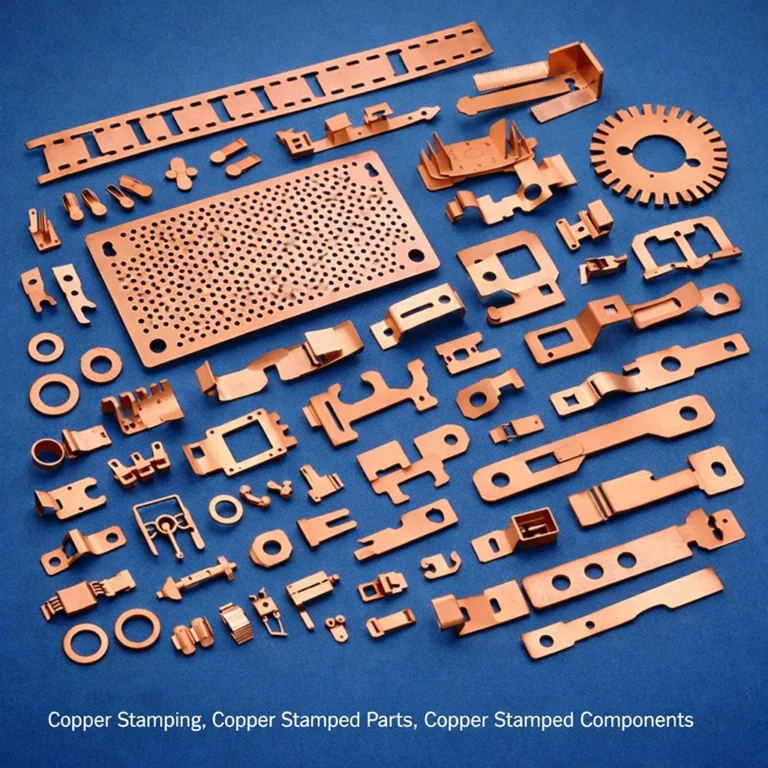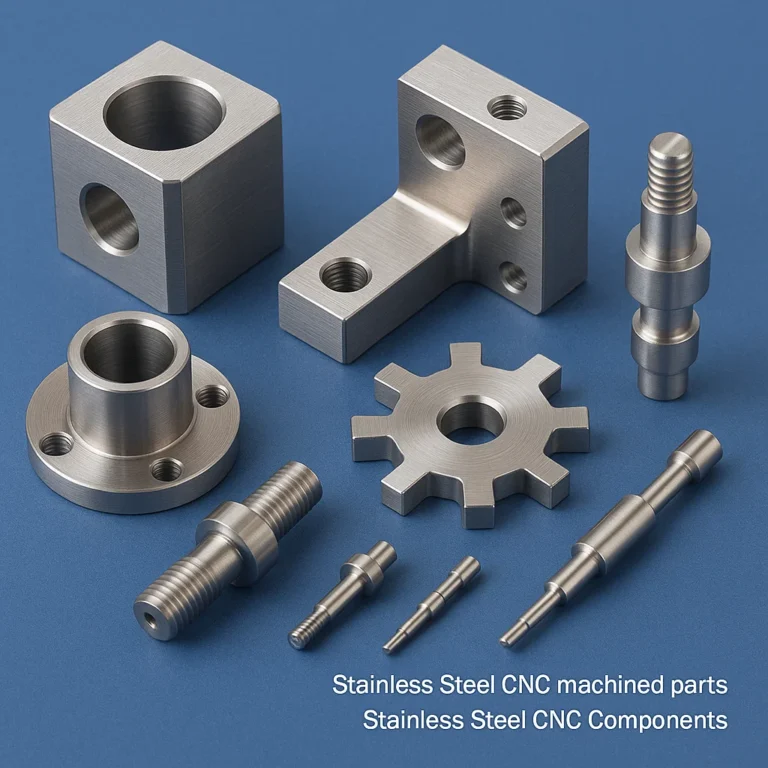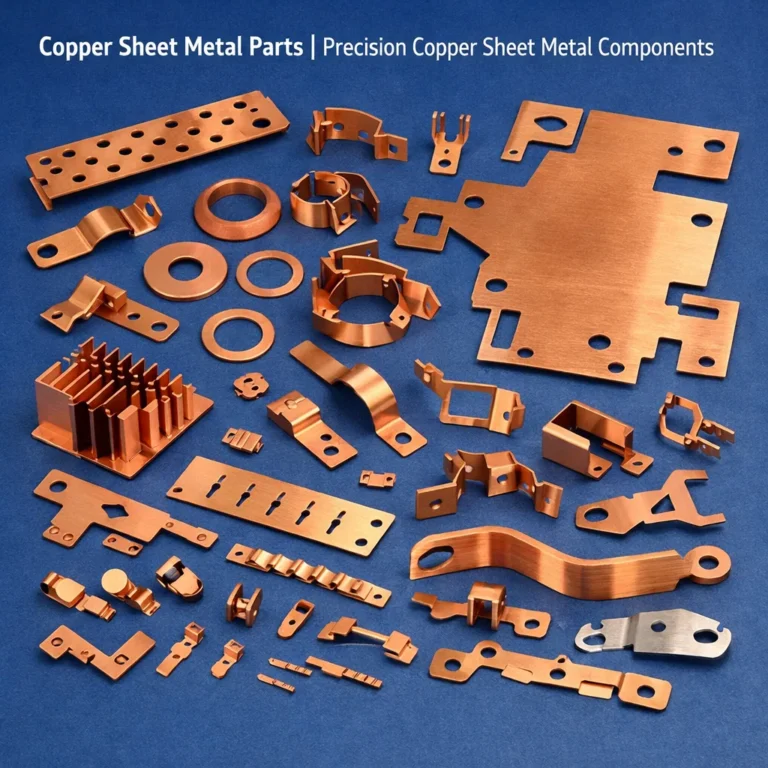
Brass & Copper Parts India is an established manufacturer and global exporter of precision stainless steel stamped parts, stainless steel stamping components, and stamped SS assemblies, serving customers across the United States, Canada, and Europe. Stainless steel stamping is one of the most technically demanding metal forming processes — requiring specialized tooling, precise press parameters, and deep material knowledge to achieve the tight dimensional accuracy and surface quality demanded by US medical, automotive, food processing, aerospace, and industrial clients.
What Is Stainless Steel Stamping?
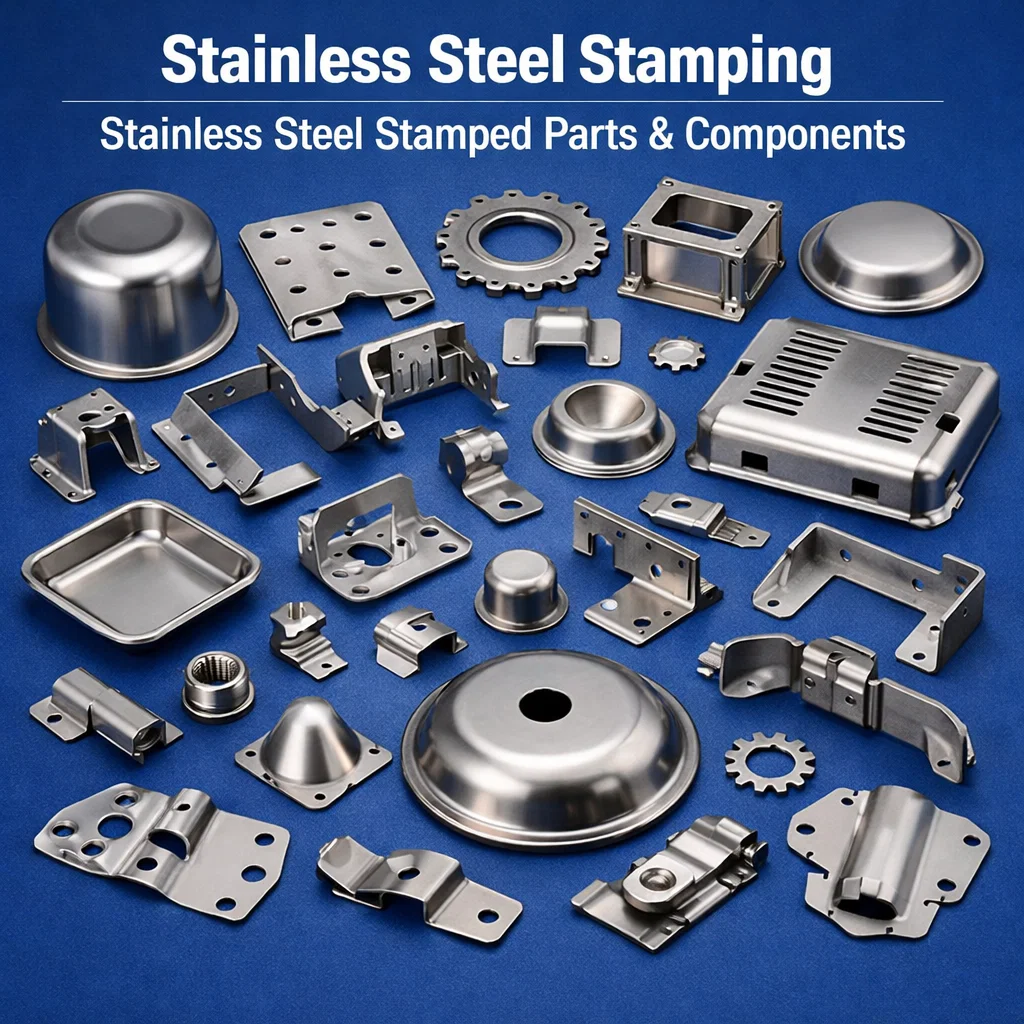
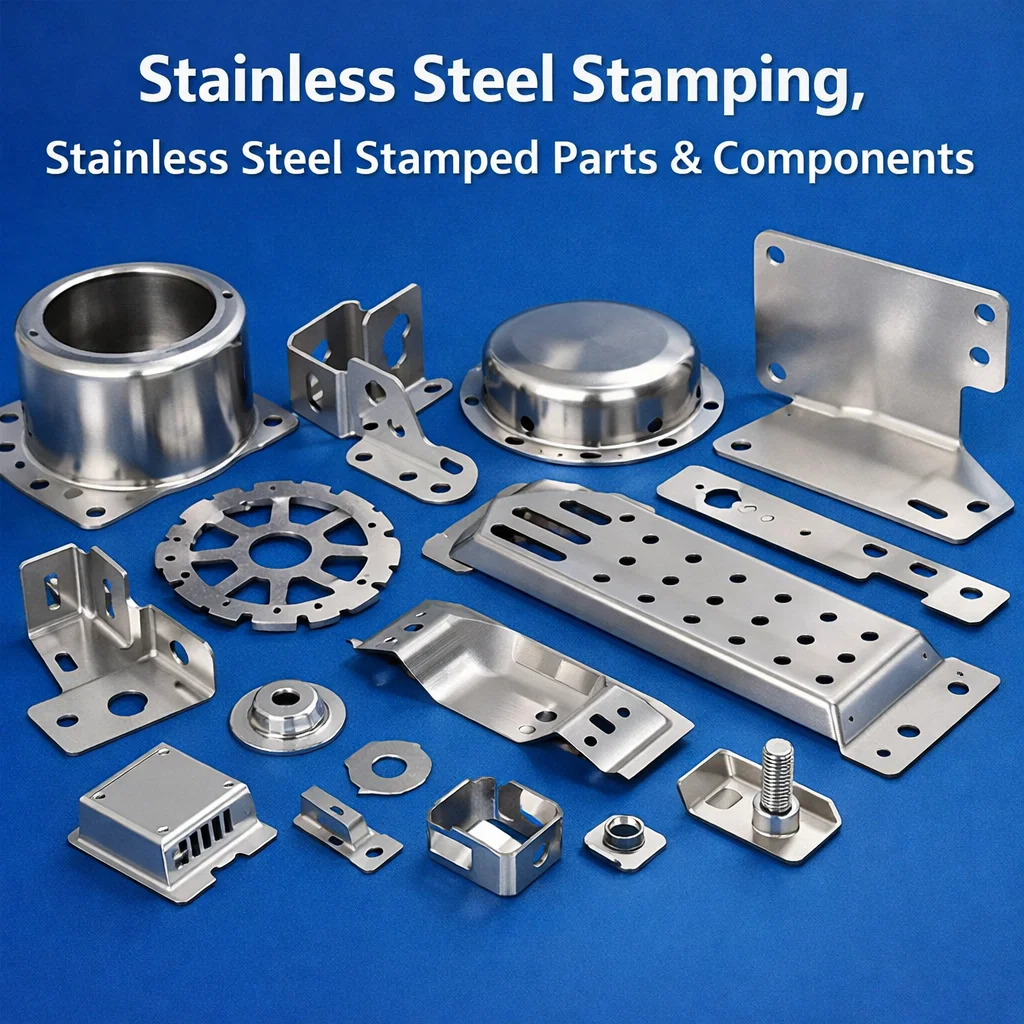
Stainless steel stamping is a cold-forming metalworking process in which stainless steel sheet, strip, or coil is fed through a stamping press equipped with precision hardened die sets to produce flat or formed parts through operations including blanking, piercing, bending, deep drawing, coining, forming, and embossing. Unlike copper or brass stamping, stainless steel stamping presents significantly higher technical challenges: stainless steel’s high work-hardening rate (especially in austenitic grades like 304 and 316) causes the material to stiffen rapidly during forming, requiring larger press tonnage, tighter die clearances, and more carefully engineered tooling with appropriate lubrication to prevent galling, die wear, and spring-back issues.
At Brass & Copper Parts India, our stainless steel stamping operations use dedicated tool steel (D2, HSS) and cemented carbide dies, servo-hydraulic presses from 50 to 500 tons, and precision servo feed systems with ±0.02 mm strip pitch accuracy. We stamp stainless steel in thicknesses from 0.1 mm to 5 mm in widths up to 400 mm, with tolerances from ±0.03 mm on blanked profiles to ±0.10 mm on formed dimensions, and burr heights held below 0.08 mm.
Stainless Steel 304 Stamped Parts and Stainless Steel 316 Stamped parts– Product Range
Our stainless steel stamping portfolio spans a broad range of component types for food processing, medical, automotive, electronics, and industrial applications. Each stamped SS part is produced with full material traceability, in-process quality control, and comprehensive outgoing inspection.
Stainless Steel Stamped Springs and Spring Components
Stainless steel stamped spring components — leaf springs, snap-action springs, spring clips, constant force springs, and flat springs — are manufactured from 301, 302, 17-7 PH, and 15-5 PH stainless steel in hard and spring tempers. These components must maintain precise spring force characteristics over millions of cycles while resisting corrosion in wet, chemical, or food-grade environments. We produce stainless steel spring stampings to tolerances of ±0.020 mm on critical geometry features, with spring-force verification testing available. Applications include medical device springs, appliance clips, automotive retainer springs, and precision instrument components for US OEM customers.
Stainless Steel Stamped Medical Device Components
Medical-grade stainless steel stampings require the highest standards of dimensional accuracy, surface finish, material traceability, and documentation. We manufacture stamped SS surgical instrument components, implantable device clips and staples, catheter components, diagnostic instrument housings, and surgical tray reinforcements from ASTM F138 (316L surgical implant grade), 17-4 PH, and 304L stainless steel. Our medical stampings comply with ISO 13485-aligned quality processes, with full lot-level material traceability, biocompatibility documentation, and surface roughness (Ra ≤ 0.4 µm) verification. We supply US medical device OEMs, contract manufacturers, and surgical instrument companies.
Stainless Steel Stamped Food Processing Components
Food-contact stainless steel stamped components must meet NSF/ANSI standards, FDA 21 CFR requirements, and 3-A Dairy Standards for hygiene and corrosion resistance. We manufacture stamped 304 and 316 SS conveyor links, food processing equipment plates, perforated screens, mixing paddle plates, auger flights, and sealing gasket retainers. All food-grade stampings are passivated per ASTM A967 or AMS 2700, with smooth, burr-free edges and surface finish Ra ≤ 0.8 µm. These are exported to US food processing equipment manufacturers, commercial kitchen equipment producers, and dairy processing OEMs.
Stainless Steel Stamped Automotive Parts
The automotive industry demands stainless steel stampings for exhaust systems, fuel system components, safety-critical clips and retainers, decorative trims, and underhood structural parts. We produce 409, 430, 304, and 316 SS stamped exhaust heat shields, fuel injection clamps, ABS sensor mounting brackets, hose clamps, and door trim clips. Our automotive stainless stampings are manufactured in IATF 16949-aligned quality systems, with PPAP documentation, Cpk studies, and DFMEA/PFMEA available for US Tier-1 and Tier-2 automotive supply chain customers.
Stainless Steel Stamped Washers and Fastener Components
Stainless steel stamped washers, lock washers, tab washers, and spring washers are manufactured to DIN, ASME/ANSI B18.21.1, and ISO standards in 18-8 (304), 316, and 316L grades. We produce flat washers, Belleville disc springs, conical washers, and custom-profile retaining washers in OD from 3 mm to 150 mm and thickness from 0.2 mm to 6 mm. These standard and custom fastener components are exported in bulk to US hardware distributors, industrial fastener companies, and OEM assembly plants.
Stainless Steel Stamped Electronic and Electrical Enclosure Parts
Stainless steel is increasingly used in electronics enclosures, shielding cans, EMI/RFI shields, grounding clips, and mounting brackets where corrosion resistance and electromagnetic shielding are required simultaneously. We produce 304 and 316 SS stamped PCB shielding cans, EMI gasket retainers, server rack components, instrument enclosure panels, and terminal box covers. Dimensional tolerances for enclosure parts are typically ±0.05 mm on panel dimensions and ±0.1 mm on formed flanges, with surface finish as stamped or with brushed/satin finish on visible surfaces per customer requirement.
Stainless Steel Deep-Drawn Cups, Shells, and Housings
Deep drawing of stainless steel requires specialized tooling with controlled draw ratios, carefully managed blank holding force, and appropriate lubricants to prevent galling and tearing. We produce deep-drawn stainless steel cups, cylindrical shells, conical housings, and rectangular boxes from 304, 316, and 430 SS in draw depths up to 5× the shell diameter. Applications include pressure vessel shells, sensor housings, medical implant shells, automotive fuel sender housings, and industrial instrument enclosures. All deep-drawn parts are supplied after inter-anneal heat treatment where required to relieve work-hardening and restore ductility for multi-stage draws.
Stainless Steel Stamped Architectural and Decorative Parts
Brushed, mirror-polished, and patterned stainless steel stampings for architectural, interior design, and luxury goods applications require exceptional surface consistency alongside dimensional accuracy. We produce 304 and 316 SS stamped door hardware, elevator cab panels, signage plates, furniture brackets, and decorative grilles with consistent brushed (No. 4) or mirror (No. 8) surface finishes maintained through the stamping and bending process. These products are supplied to US architectural hardware manufacturers, interior design firms, and luxury furniture producers.
Stainless Steel Grades – International Reference Table
Selecting the correct stainless steel grade is critical for corrosion performance, formability, mechanical properties, and compliance with industry-specific standards. The following table provides a comprehensive cross-reference of stainless steel grades used in stamping applications:
| AISI/SAE (USA) | UNS | EN / DIN (Europe) | BS (UK) | JIS (Japan) | IS (India) | Key Properties | Typical Stamping Applications |
|---|---|---|---|---|---|---|---|
| 301 | S30100 | 1.4310 / X10CrNi18-8 | 301S21 | SUS301 | 04Cr17Ni8 | High work hardening; spring temper available | Springs, snap-action clips, retainers, fasteners, wave springs |
| 302 | S30200 | 1.4300 / X10CrNi18-8 | 302S25 | SUS302 | 04Cr18Ni8 | Slightly higher C than 304; good formability | General purpose stampings, springs, hardware |
| 304 | S30400 | 1.4301 / X5CrNi18-10 | 304S15 | SUS304 | 06Cr19Ni10 | Most widely used austenitic; excellent corrosion resistance | Food equipment, enclosures, automotive trim, washers, medical parts |
| 304L | S30403 | 1.4307 / X2CrNi18-9 | 304S11 | SUS304L | 022Cr19Ni10 | Low carbon; superior weld corrosion resistance | Medical implants, food processing, chemical equipment stampings |
| 316 | S31600 | 1.4401 / X5CrNiMo17-12-2 | 316S31 | SUS316 | 06Cr17Ni12Mo2 | Mo addition; superior chloride corrosion resistance | Marine, chemical, pharmaceutical, food processing stampings |
| 316L | S31603 | 1.4404 / X2CrNiMo17-12-2 | 316S11 | SUS316L | 022Cr17Ni12Mo2 | Low carbon; surgical implant grade | Surgical implants, deep-drawn medical shells, pharmaceutical equipment |
| 409 | S40900 | 1.4512 / X2CrTi12 | 409S17 | SUS409 | 06Cr11Ti | Ferritic; lower cost, good formability | Automotive exhaust systems, heat shields, muffler stampings |
| 430 | S43000 | 1.4016 / X6Cr17 | 430S15 | SUS430 | 10Cr17 | Ferritic; good corrosion resistance, decorative | Appliance panels, automotive trim, architectural stampings |
| 17-4 PH | S17400 | 1.4542 / X5CrNiCuNb16-4 | — | SUS630 | — | Precipitation hardening; high strength post-aging | Aerospace clips, medical springs, precision instrument stampings |
| 17-7 PH | S17700 | 1.4568 / X7CrNiAl17-7 | — | SUS631 | — | Best combination of strength + formability in SS | High-cycle springs, aerospace fasteners, precision stampings |
Stainless Steel Stamping Process – Technical Considerations
Stainless steel’s work-hardening behavior requires specific stamping process adaptations compared to carbon steel or non-ferrous metals. Key technical parameters in our stainless steel stamping operations include die clearance of 6–10% of material thickness per side (tighter than carbon steel) to achieve clean cut edges while managing work-hardening, D2 or M2 tool steel dies hardened to HRC 62–65 or cemented carbide for long die life on high-volume SS programs, heavy-duty stamping lubricants (sulfurized or chlorinated oils) to prevent galling on die surfaces and SS strip contact, spring-back compensation built into die designs (SS spring-back is 2–3× higher than equivalent carbon steel), annealing between draw stages for deep-drawn components requiring multiple operations, and 100% burr measurement and edge inspection on safety-critical components including medical and food-grade parts.
Surface Finishing and Secondary Operations
Stainless steel stampings can be supplied in a wide range of surface conditions and with value-added secondary operations. We offer electropolishing for smooth, passive surfaces on medical and food-grade parts (Ra ≤ 0.2 µm achievable), passivation per ASTM A967 and AMS 2700 for corrosion protection, brushed/satin finish (No. 4) for architectural and appliance parts, mirror finish (No. 8) for decorative components, glass bead and shot blasting for matte uniform surface texture, PVD coating (gold, black, colored finishes) for decorative hardware, laser engraving and part marking, precision bending, forming, and assembly operations, and welded assemblies (TIG, laser) for multi-part stampings requiring joining.
Quality Assurance for Stainless Steel Stampings
Our stainless steel stamping quality system is designed to meet the rigorous standards of the US medical, automotive, food processing, and aerospace markets. Key quality elements include ISO 9001:2015 certified quality management system, material verification by PMI (positive material identification) using XRF to confirm grade and composition, hardness testing on heat-treated components, dimensional inspection using CMM, optical comparator, and vision inspection systems, AQL-based sampling on all outgoing lots with lot traceability, electropolishing and passivation verification by ferric sulfate or copper sulfate testing per ASTM A967, RoHS and REACH compliance for all surface treatments, and FDA-compliant documentation packages for medical device supply chain customers.
Why Choose Brass & Copper Parts India for Stainless Steel Stamping?
US manufacturers sourcing stainless steel stampings need a partner who truly understands the technical demands of SS forming — not just a generic stamping shop that stamps SS in addition to carbon steel and copper. Here is why we are the preferred India-based SS stamping partner for US companies:
- Specialized SS Tooling Technology: Our die designs account for stainless steel’s unique work-hardening rate, spring-back characteristics, and galling tendency. We use D2 and carbide tooling with optimized clearances specifically engineered for each SS grade and thickness, achieving longer tool life and consistent part quality over millions of pieces.
- Medical-Grade Capability: We are experienced in manufacturing stainless steel stampings to ISO 13485-aligned quality requirements, with full material traceability, biocompatibility documentation, and surgical-grade surface finish (Ra ≤ 0.4 µm) — capabilities that most stamping shops do not offer.
- Food-Grade and NSF Compliance: Our food-grade SS stampings are passivated and finished to NSF/ANSI and FDA standards, with complete compliance documentation for US food processing and commercial kitchen equipment OEMs.
- IATF 16949-Aligned Automotive Quality: Our automotive SS stamping programs are managed under IATF 16949-aligned quality systems with PPAP, FMEA, Control Plans, and capability studies (Cpk ≥ 1.67) supporting US automotive Tier-1 and Tier-2 suppliers.
- Competitive India Pricing: Stainless steel stampings from India are typically 35–55% lower in per-piece cost compared to equivalent US or European stamping shops, driven by lower labor and overhead costs without any reduction in tooling quality, material certification, or dimensional accuracy.
- Wide Grade Range: We work across the full spectrum of austenitic (304, 304L, 316, 316L), ferritic (409, 430), and precipitation-hardening (17-4 PH, 17-7 PH) stainless steels, enabling customers to consolidate their SS stamping supply to a single trusted vendor.
- Fast Tooling and Short Lead Times: Our in-house tool room delivers SS progressive die tooling in 4–6 weeks from drawing approval, with first-article samples within 2 weeks of tooling completion. Volume production lead times are 3–5 weeks, enabling US buyers to maintain competitive inventory cycles.
- Transparent Supply Chain: Every order shipped to US customers comes with full export documentation — commercial invoice, packing list, material test certificates, certificate of origin, and RoHS/REACH compliance declaration — ensuring smooth US customs clearance and complete supply chain transparency.
Industries Served with Stainless Steel Stamped Components
Our stainless steel stampings serve the medical device industry (surgical instruments, implant clips, catheter components), automotive sector (exhaust heat shields, fuel system components, trim parts), food processing equipment (conveyor parts, processing screens, sealing components), pharmaceutical manufacturing (equipment panels, filter housings, reactor clips), architectural and design (decorative panels, door hardware, signage), electronics and telecommunications (EMI shields, PCB enclosures, grounding clips), marine and offshore (corrosion-resistant fasteners, clips, structural parts), aerospace and defense (precision springs, structural clips, RF shields), and industrial automation (sensor mounts, actuator springs, safety guards).
Frequently Asked Questions – Stainless Steel Stamping
Q1. What is the minimum thickness of stainless steel you can stamp?
We routinely stamp stainless steel from 0.1 mm (100 microns) thickness in 301 and 304 grades for spring and clip applications. For grades with higher work-hardening (such as 316 and 17-7 PH), the practical minimum thickness for progressive stamping is approximately 0.15 mm. For ultra-thin SS below 0.1 mm, photochemical etching may be a more appropriate process — our engineering team can advise on the best technology for your specific application.
Q2. Can you stamp duplex stainless steel (2205)?
Yes. We have experience stamping duplex stainless steel (UNS S32205 / 1.4462) and lean duplex grades for applications requiring superior chloride resistance and higher strength than 304 or 316. Duplex SS requires higher press tonnage (approximately 1.5–2× that of 304 for the same thickness) and tighter process control to manage its higher work-hardening rate and spring-back. Please consult our engineering team with your drawing and production volume for a stamping feasibility assessment.
Q3. Do you perform passivation on stainless steel stampings?
Yes. We perform citric acid passivation (per ASTM A967, AMS 2700 Method C) and nitric acid passivation (per ASTM A967, Method A) on stainless steel stampings. Passivation test verification is performed using copper sulfate test or high humidity testing per ASTM A380. Full passivation certificates are provided with every treated shipment, supporting compliance documentation for medical, food, and aerospace customers.
Q4. What tooling material do you use for stainless steel dies?
For stainless steel progressive stamping, we use D2 tool steel (HRC 62–65) as our standard tooling material, which provides a good balance of wear resistance and toughness for most SS grades and thicknesses. For high-volume programs (>1 million pieces/year) or for abrasive grades like 17-7 PH, we use cemented carbide (WC-Co) tooling with significantly extended die life — typically 5–10× longer than D2. All our tool steel is sourced from certified suppliers and hardness-verified before die assembly.
Q5. Can you supply electropolished stainless steel stampings for medical use?
Yes. We offer electropolishing of stainless steel stampings to achieve Ra ≤ 0.2 µm (equivalent to Ra 8 µin) on all part surfaces, including inside bends and formed features. Electropolished surfaces provide enhanced biocompatibility, reduced bacterial adhesion, and superior corrosion resistance for medical device applications. All electropolished parts are verified by surface roughness measurement and supplied with Ra data in the inspection report.
Q6. What is your capability for deep drawing stainless steel?
We can deep-draw austenitic stainless steel (304, 316, 301) to a maximum draw ratio (DR) of approximately 2.0 in a single draw without annealing, and to DR 3.5–4.0 with inter-anneal treatment between draw stages. Wall thickness in deep-drawn SS is typically within ±8% of nominal blank thickness. All deep-drawn parts are supplied after stress-relief annealing unless the customer specifies the work-hardened condition for added strength.
Q7. Do you offer stainless steel stampings with PVD coating?
Yes. We offer PVD (physical vapor deposition) coating on stainless steel stampings for decorative architectural and hardware applications. Available PVD finishes include titanium nitride (gold color), titanium carbonitride (black), and custom color tones. PVD coating thickness is typically 2–5 µm, providing excellent abrasion resistance, color consistency, and corrosion protection. PVD-coated SS stampings are used in architectural door hardware, luxury furniture, and decorative appliance trim.
Q8. Can you manufacture stainless steel stampings to ASTM or ASME standards?
Yes. We manufacture stainless steel stampings to applicable ASTM and ASME standards including ASTM A240 (flat-rolled stainless for pressure vessels), ASTM A666 (annealed or cold-worked austenitic stainless), ASTM F138 (surgical implant-grade SS), ASTM A967 (passivation), and ASME B16.9 profiles where applicable. Mill test certificates referencing the applicable standard are provided with every material shipment. Custom documentation requirements for specific ASTM or ASME compliance are accommodated upon request.
Request a Quotation for Stainless Steel Stamped Parts
Partner with Brass & Copper Parts India for your stainless steel stamping requirements and gain access to precision SS stampings at India-competitive prices — with the material traceability, quality documentation, and customer support that US medical, automotive, food processing, and industrial OEMs demand. Submit your technical drawings, material specification, quantity requirements, and quality requirements, and receive a detailed quotation within 24–48 business hours.